Categories
Uncategorized

Learning Pandas for Data Science – Ranking Your Skills Efficiently

Getting Started with Pandas

Pandas is a powerful Python library used for data manipulation and analysis. It provides data structures and functions needed to work efficiently with structured data.

Starting with Pandas entails setting up your environment, understanding core data structures like Series and DataFrames, and performing basic operations with various data types.

Installing Pandas and Setting Up the Environment

To begin using Pandas, it is essential to have Python installed. It can be downloaded from the official Python website.

Once Python is installed, Pandas can be added to any project with the command pip install pandas. This command downloads and installs the library along with its dependencies.

Using a virtual environment is recommended to manage packages separately for each project.

Setting up involves configuring an Integrated Development Environment (IDE) or using Jupyter Notebook, which is popular for data science tasks. These tools offer features like syntax highlighting and debugging. They help streamline coding and make it easier to test and run Pandas commands.

After installation, users can import Pandas in their scripts with import pandas as pd, where pd is a common alias used to reference the library in code.

Understanding Pandas Data Structures: Series and DataFrames

Pandas revolves around two core data structures: Series and DataFrames. A Series is a one-dimensional labeled array capable of holding any data type. Each element in a Series is assigned an index label, making it similar to a list but with added capabilities.

For instance, a Series can store numbers, text, or even dates.

A DataFrame is a two-dimensional labeled data structure with columns that can hold different data types. It is similar to a table in a database or a spreadsheet in Excel. Each column and row in a DataFrame is a Series.

The flexibility of a DataFrame allows it to be used for various data operations like filtering and transforming data.

Data Types and Basic Operations in Pandas

Pandas works efficiently with various data types, including integers, floats, and strings. It also handles datetime objects, making it useful for time series analysis.

Defining the correct data type for each column can optimize performance and ensure accuracy in calculations.

Basic operations in Pandas include selecting, filtering, and modifying data. Users can select specific columns or rows using labels or conditions.

For example, use DataFrame.loc[] for label-based indexing. Modifying data involves operations like adding or deleting columns and concatenating datasets.

With these operations, users can efficiently manage and prepare data for more advanced analysis.

Data Importing Techniques

A laptop displaying a code editor with a Python script open, surrounded by open books on data science and pandas

Understanding how to import data is crucial when working with pandas. This guide covers the essential techniques for reading data from CSV files, importing JSON data, loading Excel spreadsheets, and connecting to SQL databases. Each method offers unique features that make pandas a versatile choice for data scientists.

Reading Data from CSV Files

CSV files are a common format for storing data and pandas makes it easy to read them. Using the read_csv function, users can load data efficiently. This method allows specifying delimiters, handling missing values, and setting data types.

The read_csv function is flexible, supporting a wide range of file encodings and metadata manipulation. For example, users can parse dates, specify columns to read, and even skip rows at the start of the file.

This level of control makes pandas an optimal choice for complex data structures found in large datasets. Additionally, after processing the data, users can save results back to a CSV using the to_csv function, maintaining data integrity and structure.

Importing Data from JSON Files

JSON files, known for their readable format, are widely used in web applications. With pandas, importing JSON data is straightforward through the read_json function.

This function allows for reading data in various formats, including dicts and lists, as JSON can represent hierarchical data formats.

When importing JSON, pandas helps translate nested data into a flat table format, which can be crucial for analysis. Users can specify orientation options, enabling them to load data according to its structure, whether it’s a column or index-based setup.

Once processed, JSON data can be exported back using to_json, offering various storage orientations for different analysis needs.

Loading Data from Excel

Excel is another popular tool for data storage, and pandas facilitates easy loading with its read_excel function. Users can specify sheet names or indexes to directly load specific sheets, which is useful for workbooks containing multiple datasets.

Pandas also handles merged cells and different file extensions, such as .xls and .xlsx.

The function provides options to parse dates, convert columns to categories, and preserve fill values. These features enable users to maintain the integrity of datasets during import.

Besides reading, pandas allows exporting DataFrames back to Excel using to_excel, with facilities to include multiple sheets in one file.

Connecting to SQL Databases

SQL databases are integral to data management, and pandas offers robust methods for accessing this data.

Using the read_sql function, users can execute SQL queries directly within pandas to import data into a DataFrame. This seamless integration is beneficial for handling large databases and complex queries.

Pandas supports parameterized queries and can control the number of returned records, allowing efficient data processing. Users can manipulate data in-memory and, if needed, write changes back using to_sql. This combination of reading and writing enables continuous data interaction without leaving the pandas environment.

Data Cleansing Essentials

Data cleansing is crucial in preparing datasets for analysis. It involves handling missing values, ensuring correct data types, and normalizing data for consistency.

Handling Missing Values in Pandas

Missing values can disrupt data analysis. In Pandas, missing values are often represented as NaN. Detecting and addressing these values is vital.

The isnull() function helps identify them, while fillna() allows filling these gaps, often with the mean or median.

In some cases, dropping rows or columns with excessive NaNs using the dropna() method is necessary. This ensures data integrity without skewing analysis. Choosing between filling and dropping depends on the dataset’s nature and the analysis goals.

With Pandas, handling missing values becomes systematic and efficient.

Type Conversions and Data Normalization

Data types must be consistent for accurate analysis. In Pandas, converting data types is simple using the astype() function. This function ensures columns have the correct types, like integers or floats.

Converting string representations of numbers to numeric types is a common task.

Normalization scales data for uniformity. It involves adjusting values to fit within a certain range, typically using a formula like (x – min) / (max – min).

This process is supported by Pandas and NumPy, assisting in transforming datasets for comparison and analysis. Data transformation ensures datasets are ready for meaningful analysis and visualization.

Data Wrangling Techniques

In data science, effective data wrangling techniques are crucial for preparing data for analysis. Techniques like sorting, filtering, and grouping transform raw data into an understandable format, unlocking deeper insights for data-driven decisions.

Sorting and Ranking Data

Sorting is a foundational task in data manipulation, allowing data to be organized in either ascending or descending order. In pandas, the sort_values function efficiently handles this process.

Users can specify columns to sort by, and even sort based on multiple columns simultaneously.

Ranking data involves assigning ordinal numbers to data values. This technique can reveal the hierarchical structure within datasets.

Whether ranking sales to identify top performers or ranking scores in a competition, this method highlights key insights.

Utilizing sorting and ranking, users can manipulate datasets to focus on the most critical elements.

Filtering and Selecting

Filtering data involves refining datasets to include only specific entries based on set conditions. This capability allows analysts to focus on relevant data.

In pandas, filtering can be done using conditions within brackets or with methods like loc and iloc.

Selecting particular columns or rows from a DataFrame is essential for working efficiently with large datasets. Users can specify exact fields to analyze, reducing needless data processing.

By combining filtering and selecting, data is managed and tailored for precise analysis. These techniques streamline workflow and enhance data handling efficiency, leading to more effective insights and results.

Grouping Data with GroupBy

GroupBy is a powerful method for aggregating data, enabling analysis across groups within a dataset. By grouping data based on column values, analysts can summarize, calculate, or compare data subsets.

This approach provides insights into patterns and trends not visible through raw data alone.

For example, using groupby with a sales dataset could highlight total earnings per region or average sales per product category.

Aggregation functions like sum, mean, or count are commonly applied during group operations.

Utilizing groupby in pandas is integral for unveiling meaningful observations in complex datasets.

Advanced Data Manipulation

Advanced data manipulation involves techniques that enhance the ability to transform and analyze data efficiently. Key operations include merging and joining dataframes to combine data as well as pivoting and reshaping data to organize it effectively.

Merging and Joining Dataframes

Merging and joining are essential operations for combining datasets in pandas. Merging allows users to connect two dataframes using a common column, known as a key. This operation can be performed in different ways like inner, outer, left, and right merges, each affecting the outcome based on the presence of key values in both dataframes.

Joining is a similar concept but aligns based on the index of the dataframes.

By using the merge and join functions, users can construct comprehensive datasets necessary for detailed analysis. These operations are critical in handling datasets from multiple sources, ensuring all relevant data is combined.

Pivoting and Reshaping Data

Pivoting is the method of transforming or pivoting a dataframe to change its structure without altering the data. The pivot method allows data restructuring, which involves changing the layout for better data insights.

It’s particularly useful when converting categorical data that needs different summarizations.

Reshaping data often involves operations like melt and stack, which transform wide-form data into long-form and vice versa.

This makes it easier to analyze specific aspects of the data.

The axis parameter plays a crucial role here, as it determines the axis along which the operation is performed. These techniques are essential for preparing the data in the required format for further analysis and reporting.

Statistical Analysis and Correlation

Statistical analysis with Pandas and NumPy can reveal patterns within data by examining summary statistics and exploring correlations. These techniques help identify relationships between variables, which is essential in data science.

Performing Summary Statistics

Summary statistics involve calculating key metrics to describe data sets. In Pandas, this can include the mean, median, mode, and standard deviation.

For example, using a Pandas DataFrame, one can quickly access these metrics with functions such as mean(), median(), and std().

NumPy complements this by offering advanced array operations.

Calculating these metrics provides insights into data distribution and identifies outliers. A Pandas Series, a single column in a DataFrame, can also be analyzed using these methods to provide a concise view of individual data components.

Exploring Data Correlation

Correlation highlights the relationship between two or more variables. In Pandas, the corr() function computes correlations, indicating how strongly variables are linked.

This is significant in predicting trends.

A correlation coefficient ranges from -1 to 1. A value close to 1 indicates a strong positive relationship, and a value near -1 indicates a strong negative one.

NumPy offers functions to support these calculations, enhancing the analysis.

Understanding these relationships helps in forming predictions and developing data-driven strategies, making it a vital component of data analysis.

Visual Data Exploration

Visual data exploration is a key skill for data scientists. It involves using tools to transform raw data into visual formats. This makes it easier to spot patterns, trends, or insights.

By using tools like Matplotlib, Seaborn, and Plotly, users can effectively plot data, create statistical visuals, and interactively explore datasets.

Plotting with Matplotlib

Matplotlib is a widely-used library in Python for creating static plots. It offers a variety of plots, such as line, bar, and scatter plots. These are essential for basic data visualization.

To start, users can create a simple line plot using plt.plot(). The library provides customization options for axes, labels, and titles. This allows for precise control over the visual elements.

Matplotlib also supports subplots, letting users compare different data sets side by side. This feature is especially useful during data exploration, as it provides immediate visual context for any changes or trends observed in the data.

This makes it a foundational tool in the visual analysis toolkit.

Using Seaborn for Statistical Visuals

Seaborn is built on top of Matplotlib and specializes in statistical plotting. It simplifies the creation of complex statistical graphs and is ideal for visualizing data distributions and relationships.

A key feature of Seaborn is its ability to produce attractive, informative visuals with minimal coding. For example, users can create a pair plot to visualize pairwise relationships across the entire dataset with just one function call.

Seaborn’s integration with Pandas allows users to directly pass data frames, streamlining the process. Additionally, Seaborn’s custom style themes make it easier to produce aesthetically pleasing graphics that highlight different aspects of data. This is particularly useful for presenting findings clearly and effectively.

Interactive Visualizations with Plotly

Plotly enables interactive data visualizations that enhance engagement and understanding. Unlike static plots, Plotly’s visuals allow users to explore data more deeply by zooming, panning, and hovering over points for more details.

A standout feature of Plotly is its ability to create complex visualizations like 3D plots and real-time data graphs. Users can easily generate interactive plots using Plotly’s Python library with simple commands.

Plotly’s interactivity makes it suitable for dashboards and data exploration interfaces, providing a more dynamic method of analyzing data. This helps users to not just visualize data but also gain a deeper understanding by interacting with it in real-time scenarios.

Time Series Analysis in Pandas

Time series analysis in Pandas is a powerful way to work with sequential data. Users can handle time-indexed data efficiently, making it easy to manage datasets containing dates and times.

Pandas provides several functions for time series manipulation. These include functions to resample data frequencies, handle missing values, and perform rolling statistics. This makes transforming and analyzing data straightforward.

One of the key features in Pandas is the ability to resample time series data. Resampling can be done to upsample or downsample data frequency. For instance, data collected monthly can be easily resampled to a yearly frequency using the resample() method.

For visual representation, Pandas offers several plotting capabilities. Time series data can be easily visualized using built-in plotting functions. By using libraries like Matplotlib in conjunction with Pandas, users can create clear and informative plots.

Data transformation is seamless in Pandas. It allows users to apply functions over data series, which can be used to clean data or apply custom calculations. This flexibility makes Pandas essential for time series analysis. The ability to effortlessly manipulate and visualize time-indexed data is a major advantage of using Pandas in data science.

Integrating with Machine and Deep Learning

A computer screen displaying a ranking chart with colorful data visualizations, surrounded by books on machine and deep learning, and a panda mascot

Pandas is a vital library for data manipulation in data science projects, providing powerful tools for preparing data for machine learning and deep learning models. Its integration with libraries like Scikit-Learn enhances the ability to process, analyze, and model data efficiently.

Using Pandas with Scikit-Learn

Pandas excels in data manipulation, while Scikit-Learn provides robust tools for building machine learning models. Combining these two can streamline data workflows. Pandas is perfect for cleaning and transforming raw data into a format that’s model-ready.

Using Pandas, data can be easily converted to arrays or data frames suitable for Scikit-Learn. This compatibility ensures seamless data transfer between preprocessing steps and model training.

Features such as Pipeline in Scikit-Learn can incorporate Pandas operations to enable complex data transformations in a unified framework. These stages form a comprehensive process where raw data becomes actionable insight, enhancing the efficiency of the machine learning pipeline.

Data Preparation for Deep Learning

Deep learning models require significant data preparation, and Pandas offers the necessary tools for this task. Data cleaning, normalization, and transformation are crucial steps, and Pandas’ functions help handle missing values, scale features, and encode categorical variables.

When preparing data for frameworks such as TensorFlow, Pandas simplifies the conversion of data frames into NumPy arrays or TensorFlow datasets.

Handling large datasets becomes manageable with Pandas’ capability to filter, aggregate, and transform data efficiently, making it an essential step before feeding data into deep learning architectures. Its role in preprocessing ensures that the input to deep learning models is optimized for performance and accuracy, supporting the creation of reliable predictive models.

Working with Large Datasets

Handling large datasets efficiently is vital for data scientists using Pandas. This includes understanding how to load data into DataFrames effectively and utilizing performance-enhancing techniques.

Efficient Data Loading

Loading large datasets quickly is important in data science. Pandas offer several ways to read data into DataFrames that are both fast and memory-efficient.

One effective strategy is using chunks with the chunk_size parameter when reading files. This allows the user to process data in manageable pieces rather than loading it all at once.

Utilizing data types is another key practice. By specifying the correct data types using the dtype parameter, the amount of memory used by the DataFrame can be reduced significantly. This results in faster load times and improved performance when working with large data.

The usecols parameter helps by allowing the selection of only the necessary columns. This further reduces memory usage and speeds up data loading.

Performance Tips and Tricks

Optimizing performance when working with large datasets in Pandas involves multiple strategies.

Vectorization is a powerful method that encourages the use of operations that apply across entire DataFrames rather than processing row by row, which improves speed.

Avoiding loops such as for or while for operations on large data is essential. Instead, using Pandas functions like apply or native methods improves efficiency. These methods are optimized for performance and allow operations to be run swiftly across large datasets.

Another trick is setting the index_col during data loading to enhance lookup performance. This makes indexing operations more efficient and quicker when performing data analysis.

Employing these techniques can significantly enhance DataFrame performance, ensuring swift and effective data processing.

Writing and Exporting Data

A laptop displaying a pandas data science tutorial with charts and graphs on the screen

Data scientists often need to store or share their data in different formats. Common ways to do this include exporting data to CSV or Excel files and writing data to JSON and SQL formats. Each method has its use cases, and grasping them can be very helpful for data handling with Pandas.

Export Data to CSV/Excel

Exporting data to CSV or Excel is a common practice in data science. With Pandas, the to_csv() function allows users to save a DataFrame to a CSV file. This function lets users specify parameters such as the file path, separator, whether to include the index, and encoding.

For Excel files, Pandas supports the to_excel() function. This requires the openpyxl or xlsxwriter library. Users can determine the spreadsheet name and even write to multiple sheets within the same file. These file types are widely used because they are easy to read and share.

Writing Data to JSON and SQL Formats

JSON is favored for its readable structure and compatibility with web applications. Pandas provides the to_json() function to convert a DataFrame into JSON format. This function offers various orientation options, such as ‘records’ or ‘index’, allowing for flexibility depending on the desired output structure.

For exporting data to SQL databases, Pandas includes the to_sql() function. This function connects DataFrames to a SQL database using an SQLAlchemy engine. Users can specify if the existing database table should be replaced or appended. These tools make it straightforward to integrate data analysis results into larger systems.

Practical Applications and Exercises

A laptop displaying a Pandas data science tutorial with ranking exercises, surrounded by notebooks and a pen

In the world of data science, understanding how to use Pandas effectively through practical applications and exercises is crucial. This section highlights real-world examples and provides exercises to hone skills in Python programming with an emphasis on tabular data analysis.

Real-World Data Analysis Examples

Using Pandas in practical scenarios helps solidify knowledge. One example is analyzing sales data to identify trends and patterns.

When working with large datasets, Pandas offers powerful functions like groupby and pivot_table to summarize data easily. Companies often use these functions to evaluate performance by different dimensions, such as month or product.

Another common application is in exploratory data analysis (EDA). By importing datasets into a Pandas DataFrame, data scientists can quickly visualize key statistics like the mean, median, and standard deviation. This is essential for understanding the data prior to any advanced analytics or machine learning tasks.

Python Pandas Exercises for Practice

Practical exercises are vital for mastering Pandas. A common exercise involves importing datasets into Jupyter Notebooks and practicing data cleaning techniques. This might include handling missing values, removing duplicates, or formatting columns to the correct data type.

Exercises can also involve data transformation. Using Pandas functions like apply, users can manipulate and extract insights from data.

For example, one might practice creating new columns based on existing ones, or merging multiple DataFrames to consolidate information.

These exercises not only improve proficiency but also prepare individuals for real-world data tasks. Practicing in a Jupyter Notebook environment enhances the learning experience by allowing users to test and visualize their code in real-time.

Frequently Asked Questions

A laptop with a data science tutorial open, surrounded by notebooks and a pen

When learning Pandas for data science, there are several things to consider, such as course options, certification exams, and free resources. It’s also important to understand Pandas’ role in modern data science and explore its advantages for your career. Alternatives for data manipulation may also be of interest.

What are the best courses to learn Pandas for data science?

There are various online platforms offering courses on Pandas. Websites like Coursera and Udemy provide comprehensive courses where learners can dive into data analysis using Pandas. These courses often cover data wrangling, cleaning, and visualization.

Where can I find a good Python Pandas certification exam?

Certification exams for Pandas are available on platforms like EdX or DataCamp. These exams test your ability to use Pandas for tasks like data manipulation and provide a certification upon successful completion, which can boost your resume.

Are there any high-quality, free resources for learning Pandas?

Yes, there are numerous free resources online. The official Pandas documentation offers extensive material. Additionally, websites like Kaggle provide notebooks and datasets that are useful for hands-on practice.

How relevant is Pandas for modern data science practices?

Pandas is highly relevant in data science today. It is widely used for data manipulation, cleaning, and analysis, making it essential for working with large datasets. Its integration with Python and other libraries makes it a favorite tool for data scientists.

What are the benefits of learning Pandas for a career in data science?

Learning Pandas equips individuals with skills to efficiently handle and analyze data. It is crucial for transforming raw data into meaningful insights, a core aspect of data science work.

Mastery of Pandas can enhance one’s career prospects and capabilities in the industry.

Are there alternatives to Pandas for data manipulation in data science?

Yes, there are alternatives to Pandas. Libraries such as Dask and Vaex are also used for data manipulation. They are especially useful when dealing with large-scale data processing. Each has its unique features and performance benefits, depending on specific project requirements.


Categories
Uncategorized

Learning Math for Machine Learning – Eigenvectors and Eigenvalues Explained Simply

Foundations of Linear Algebra

Linear algebra is a field of mathematics essential for machine learning. It focuses on vectors and vector spaces, as well as matrices and their operations. These concepts form the backbone of data processing and analysis.

Vectors and Vector Spaces

Vectors are fundamental in linear algebra. A vector is a list of numbers that can represent points in space. They have both magnitude and direction.

Vectors help in describing physical quantities like force and velocity. In a vector space, vectors can be added together and scaled by numbers, known as scalars.

Vector spaces are defined over fields and require operations like addition and scalar multiplication to satisfy certain properties such as closure, associativity, and distributivity. Understanding these properties is crucial to analyzing complex data.

Matrices and Matrix Operations

Matrices are rectangular arrays of numbers arranged in rows and columns. They are used to represent linear transformations and systems of linear equations.

Basic operations with matrices include addition, subtraction, and matrix multiplication. Matrix multiplication combines data in a way that preserves the structure of linear equations.

The identity matrix acts like the number one in matrix arithmetic. It does not change other matrices when involved in multiplication.

A square matrix has the same number of rows and columns, and it has special properties that are important in computational tasks. Mastery of these operations is vital in areas such as graphics, cryptography, and machine learning.

Core Principles of Math in Machine Learning

Mathematics is a fundamental part of machine learning. It helps in understanding algorithms and improving models. To excel in this field, one needs a strong grasp of several mathematical concepts.

Linear Algebra plays a key role. It’s essential for working with vectors and matrices, which form the basis of many algorithms. Concepts like eigenvectors and eigenvalues are crucial for techniques such as Principal Component Analysis (PCA). You can explore these in Mathematics for Machine Learning.

Calculus is vital for optimizing algorithms. It helps in understanding how changes in input affect the output. This is particularly important in training deep learning models, where derivatives are used to minimize errors.

Probability and Statistics enable practitioners to make predictions and deal with uncertainty in data. Techniques such as Bayesian networks rely heavily on these concepts.

Python is the most popular programming language in AI and data science. Libraries like NumPy assist with complex calculations, making it easier to implement math-based solutions in machine learning. An insight into these operations can be found in the Deep Learning and Machine Learning tutorial.

Solid math skills are indispensable for anyone interested in AI and data science. Understanding mathematical principles allows one to interpret data and create accurate models effectively.

Eigenvalues And Their Significance

Eigenvalues are a core concept in linear algebra, with significant applications in various fields, including machine learning and data analysis. Their primary importance lies in simplifying complex systems and matrices through transformation and dimensionality reduction.

Understanding Eigenvalues

Eigenvalues are scalars associated with a matrix that provide insights into the matrix’s properties. When a matrix is transformed, the eigenvalue indicates how much an eigenvector is stretched or compressed.

Matrices often arise in applications involving transformations, and eigenvalues help in understanding these changes. They are essential in determining the stability of systems, aiding in calculations where complex matrix equations are simplified.

In machine learning, eigenvalues are used in techniques such as Principal Component Analysis (PCA). Here, eigenvalues help rank dimensions by importance, allowing data to be reduced efficiently.

When the eigenvalues are large, they suggest that the direction associated with their eigenvectors significantly impacts the system, which is critical for model predictions. In this way, understanding the eigenvalues of a matrix provides a deep insight into its characteristics.

Characteristic Equation

The characteristic equation is a polynomial obtained from a matrix by subtracting a scalar multiple of the identity matrix from the original matrix and calculating its determinant.

It is given by the equation: det(A – λI) = 0, where A is the matrix, λ is the eigenvalue, and I is the identity matrix.

Solving this equation yields the eigenvalues of matrix A.

In practice, solving the characteristic equation is crucial for finding eigenvalues in many applications. It aids in performing eigenvalue classification, especially in computational algorithms involving data processing, optimization, and more.

The solutions provide values reflecting various transformation properties and stability indicators, offering a window into the matrix’s behavior. This concept is fundamental in the study and application of eigenvalues across diverse scientific disciplines.

Eigenvectors Explained

Eigenvectors play a critical role in understanding various mathematical concepts, especially in machine learning and data analysis. They offer insights into linear transformations and other mathematical operations.

Interpreting Eigenvectors

Eigenvectors are vectors that do not change direction during a linear transformation. While their magnitude might be scaled, their direction remains constant.

For example, in a geometric sense, imagine a transformation that stretches or compresses, yet the eigenvector maintains its original orientation.

Mathematically, an eigenvector (\mathbf{v}) of a matrix (A) satisfies the equation (A\mathbf{v} = \lambda\mathbf{v}), where (\lambda) is the eigenvalue. This means that when matrix (A) is applied, the vector (\mathbf{v}) is stretched by a factor of (\lambda).

Knowing how to interpret eigenvectors helps in many applications, such as explaining data variance in principal component analysis or understanding the dynamics in systems governed by differential equations. The direction given by eigenvectors often reveals crucial information about the system or data structure being studied.

Eigenvectors in Linear Transformations

In linear transformations, eigenvectors describe invariant directions in vector spaces. When vectors undergo transformations, eigenvectors specify the paths that remain proportionally unchanged, which is key in simplifying complex mathematical models.

For example, consider a transformation matrix in computer graphics. Applying this matrix to a vector results in rotation, scaling, or reflection.

If a vector is an eigenvector, it retains its fundamental direction even as it might be resized. This property is essential in discerning important attributes in data, such as identifying principal components in datasets or solving stability problems in engineering.

By exploring how eigenvectors act during these transformations, one can grasp their effectiveness in solving practical problems across various fields.

Dimensionality Reduction Techniques

Dimensionality reduction is crucial in simplifying complex datasets by reducing the number of variables while preserving essential information. Two main techniques are Principal Component Analysis (PCA) and Singular Value Decomposition (SVD), both used to manage data more efficiently and improve computational performance.

Principal Component Analysis (PCA)

PCA is a widely-used method for dimensionality reduction. It works by identifying the directions (principal components) in which data varies the most. These components are linear combinations of the original variables and are orthogonal to each other.

The process involves finding the top eigenvectors of the data’s covariance matrix. These eigenvectors represent the principal components, and the ones with the highest eigenvalues capture the most variance in the data.

PCA can reduce a dataset to a lower-dimensional space, making it easier to analyze without losing significant information. It is especially effective in fields like image processing and genomics where data can be overwhelming.

Singular Value Decomposition

Singular Value Decomposition (SVD) is another powerful dimensionality reduction tool. SVD decomposes a matrix into three smaller matrices, revealing the intrinsic properties of the original matrix. It represents the matrix as a product of its singular vectors and singular values.

The singular values in SVD are akin to the eigenvalues in PCA, indicating the importance of each dimension. By zeroing out smaller singular values, SVD reduces noise and compresses the data effectively.

This method is particularly useful in signal processing and natural language processing, where datasets need to be compressed while retaining meaningful structures.

Python for Math Applications

Python is a powerful tool for mathematical computations, often used for statistics, probability, and linear algebra. It offers libraries that simplify complex tasks, making it accessible for those learning machine learning concepts like eigenvectors and eigenvalues.

Numpy in Mathematics

Numpy is a popular Python library used to perform numerical operations efficiently. It provides support for large multi-dimensional arrays and matrices, along with a vast collection of mathematical functions.

For mathematics, Numpy is crucial because it allows operations on entire arrays without needing explicit loops. This makes computations faster and simpler.

Users find Numpy’s linear algebra capabilities particularly helpful for calculating eigenvectors and eigenvalues, which are key concepts in machine learning and data analysis.

By utilizing Numpy, tasks such as matrix multiplication, finding determinates, and performing eigen decomposition become streamlined.

Its integration with Python enhances the learning process by allowing users to apply mathematical theories in practice. Numpy’s comprehensive documentation also makes it easier to get started and use effectively.

Python Examples

Python shines in its ability to execute mathematics through clear and concise code. For example, calculating eigenvectors and eigenvalues is straightforward with Numpy. Here is a simple illustration:

import numpy as np

matrix = np.array([[4, -2], [1, 1]])
eigenvalues, eigenvectors = np.linalg.eig(matrix)

print("Eigenvalues:", eigenvalues)
print("Eigenvectors:\n", eigenvectors)

This script showcases how Python’s Numpy library can be used to achieve complex calculations with minimal lines of code. Such examples demonstrate the practical application of mathematical theories and make Python an excellent choice for learning and teaching statistics and probability.

Mathematical Pedagogy in AI

Mathematics is the foundation of many concepts in machine learning, such as eigenvectors and eigenvalues. Understanding how math is taught for AI reveals the shift from traditional methods to modern approaches.

Traditional vs Modern Methods

Traditional mathematics pedagogy often focuses on rote memorization and procedural knowledge. Students usually learn through lectures and solve set problems to apply formulas. This method creates a strong base but might miss fostering problem-solving skills.

With machine learning, there is a need for a deeper practical approach. Modern methods emphasize conceptual understanding and collaborative learning tactics.

These include project-based learning, which engages students with real-world machine learning problems. Interactive platforms and software are also used to simulate complex AI systems, making abstract concepts more concrete and understandable.

Teaching Math for AI

Teaching math specifically for AI involves focusing on applicable topics such as linear algebra, calculus, probability, and statistics. These areas are crucial because they are the backbone of machine learning algorithms. Educators push for a curriculum that integrates these disciplines effectively.

Introducing coding exercises alongside math theories helps in constructing a bridge between math concepts and AI applications.

Using programming languages like Python allows students to write algorithms, giving them hands-on experience with machine learning models. Encouraging the use of digital tools for visualization assists in grasping complicated ideas, promoting a more engaging and efficient learning process.

Scalability and Efficiency

Understanding scalability and efficiency in computations is essential for advancing machine learning applications. These aspects ensure that algorithms remain robust and perform well even as data sizes grow.

Optimizing Algebraic Computations

In machine learning, optimizing algebraic computations is crucial for efficiency. A common approach is to improve the speed of matrix operations, which are central to many algorithms.

Tools like numpy or scipy enable faster computations by leveraging optimized mathematical libraries.

Parallel processing can also be utilized to perform calculations more quickly by splitting tasks across multiple processors. This significantly reduces computation time and makes processes scalable.

As algorithms become more complex, especially in AI applications, improving algebraic computations can greatly enhance performance and make it feasible to handle large datasets common in industries using advanced algorithms to upskill.

Scaling Algorithms in ML

Scaling algorithms efficiently in machine learning involves adapting them to manage larger datasets and more complex models. One method is distributing computations across clusters or using cloud computing platforms. This approach allows for handling vast amounts of data without a drop in performance.

Efficient algorithms for calculating large-scale eigenvectors, like those discussed in large-scale generalized eigenvector computation, illustrate the importance of balancing computational load.

By focusing on scalable machine learning practices, it becomes possible to maintain accuracy and efficiency in AI systems. This ensures that machine learning models can keep pace with rapidly growing data volumes while still developing essential math skills.

Algebra in Computer Vision

Algebra plays a crucial role in computer vision, particularly with matrices and vectors. These mathematical tools help in processing and understanding images.

Matrices are used to transform images in various ways. Whether rotating, scaling, or translating images, matrices help perform these operations efficiently.

Vectors are essential in representing features of images. They aid in image recognition, a key task in computer vision applications, including facial recognition and object detection.

Python is often used in computer vision tasks because of its versatile libraries. Tools like OpenCV and TensorFlow allow easy manipulation of matrices and vectors.

In deep learning, algebra is vital for training models. Convolutional neural networks (CNNs) heavily rely on matrix operations to process image data. These models improve AI by enhancing how systems understand visual information.

For those interested in learning more about these concepts, the study of eigenvectors and eigenvalues can be beneficial. These are often applied in geometric transformations and data reduction tasks. The study of eigenvectors and eigenvalues helps in the visualization and interpretation of image data.

Algebraic methods provide the backbone for many computer vision applications, offering powerful tools to solve complex problems in artificial intelligence.

Real-World Applications

Eigenvectors and eigenvalues are crucial in many technology fields. They play a vital role in algorithms and machine learning methods. Additionally, they are important in data science, impacting how AI processes information.

PageRank Algorithm

The PageRank algorithm, developed by Google, is a clear example of eigenvectors and eigenvalues in action. In this context, the algorithm uses a webpage’s link structure to rank its importance.

Think of the web as a network where each page represents a node. The algorithm uses a large matrix that reflects the link connections between these pages.

This matrix is then analyzed to find its eigenvalues and eigenvectors. By doing this, the algorithm identifies which pages should be seen as more authoritative and relevant.

This ranking process helps determine search result order. PageRank illustrates how these mathematical concepts are applied in real-world scenarios to make AI more effective.

Machine Learning Use-Cases

In machine learning, eigenvectors and eigenvalues help simplify data complexity. They aid in reducing dimensions while retaining important information.

One well-known method that uses these math concepts is Principal Component Analysis (PCA). PCA allows data scientists to transform large datasets into smaller, more manageable forms.

This is particularly useful for visualizing high-dimensional data in two or three dimensions. By keeping only the significant components, PCA improves data processing efficiency.

EigenClass, another machine learning method, uses eigenvalues for classification tasks. It improves accuracy and stability in predictions. Such methods are essential in enabling AI to handle real-world data, thus enhancing decision-making and predictive capabilities in practice.

Advanced Mathematical Concepts

The application of advanced mathematical concepts is integral to understanding machine learning. Key topics include calculus and complex statistical measures, which play significant roles in optimization and data analysis.

Calculus in Machine Learning

Calculus is essential for optimizing algorithms in machine learning. It helps with understanding how functions behave, which is crucial for algorithms that learn from data.

The concept of derivatives allows for determining the slope of a curve, aiding in minimizing or maximizing functions.

Gradients are used to find the direction of steepest ascent or descent, helping in optimizing the function.

Partial derivatives allow for understanding functions with multiple inputs, which is key for multivariate models. Calculus assists in tuning parameters to get the best predictions from a model.

Complex Statistical Measures

Statistics provide the tools to interpret and make predictions from data. Measures like mean, variance, and standard deviation form the foundation of data analysis.

Probability theory is used to model and predict outcomes, which is crucial in algorithms for tasks such as classification and regression.

Understanding correlation and regression helps in identifying relationships between variables.

Complex statistical tools, like hypothesis testing and determinants, assist in making decisions based on data. These measures help in validating models and understanding the data’s structure, providing insights for better algorithm design.

Challenges in Learning Math for AI

Learning math for artificial intelligence can be tough due to several reasons. Traditional mathematics pedagogy often emphasizes theory over application. This approach can make it hard for students to see how math like eigenvalues relates to AI.

Machine learning relies heavily on concepts such as matrices and eigenvectors. These topics can seem abstract and hard to grasp. Many students find themselves struggling to connect these mathematical ideas to real-world AI applications.

Practice doing math is essential. Without regular practice, it becomes difficult to understand and apply mathematical concepts in AI. Students often need guided practice to bridge the gap between theory and practical application.

The vocabulary used in mathematics and AI can be another barrier. Specialized terms and symbols may feel alien, leading to misunderstanding. A strong focus on developing clear definitions and examples can help ease this challenge.

AI complexity adds another layer of difficulty. As AI evolves, so does the level of math needed. Keeping up with the rapidly changing technology while mastering complex math is often challenging for learners.

Using real-world applications and step-by-step visualization, like those studied by math majors, can make learning math for AI more engaging and less daunting. Access to resources like deep learning architecture books can further enhance understanding.

Frequently Asked Questions

Eigenvalues and eigenvectors play critical roles in machine learning, particularly in areas such as dimensionality reduction and data analysis. These concepts facilitate understanding data structures and optimizing machine learning algorithms.

How are eigenvalues and eigenvectors applied in machine learning algorithms?

Eigenvalues and eigenvectors assist in simplifying data structures, making complex algorithms easier to handle. They help identify principal components in datasets, which is crucial for algorithms like Principal Component Analysis (PCA).

What is the significance of eigenvalues and eigenvectors in dimensionality reduction techniques?

In dimensionality reduction, eigenvalues determine the importance of corresponding eigenvectors. Techniques like PCA use them to reduce large datasets into smaller, more manageable ones while preserving important data patterns.

How do eigenvalues and eigenvectors contribute to understanding data distributions in machine learning?

Eigenvalues and eigenvectors reveal variance within datasets, showing the directions of maximum data spread. This insight helps in identifying underlying patterns and correlations in the data, which is essential for classification and clustering tasks.

What methods are commonly used to compute eigenvalues and eigenvectors in numerical computations?

Common methods include the QR algorithm, power iteration, and singular value decomposition. These approaches facilitate efficient computation, which is important for handling large datasets typical in machine learning applications.

In what ways do eigenvalues and eigenvectors play a role in optimizing machine learning models?

They reduce complexity in models by aiding in feature selection and transformation. By focusing on the most significant features, they improve model performance and decrease computational costs.

What is the intuitive explanation of eigendecomposition in the context of machine learning?

Eigendecomposition breaks down matrices into eigenvalues and eigenvectors. This explains data transformations. It allows models to understand linear transformations in data. It provides a clearer picture of data structure and dynamics.

Categories
Uncategorized

Learning Pandas for Data Science – Essential Tool for Data Manipulation

Getting Started with Pandas

Pandas is a powerful Python library used for data manipulation and analysis. It is commonly employed in data science to handle structured data efficiently.

Starting with Pandas involves installing it and integrating it effectively with Python.

Installing Pandas

To begin using Pandas, one must first install the package. The easiest method is through the Python package manager, pip.

Simply open a terminal or command prompt and type pip install pandas. This command downloads and installs the latest version of Pandas along with its dependencies.

For those using Anaconda, Pandas often comes pre-installed. However, users can update it by using the command conda install pandas.

Keeping Pandas up-to-date ensures access to new features and bug fixes.

Installation is usually straightforward, and any issues can often be resolved by checking network connections or permissions.

Pandas for Python

Pandas is designed to work seamlessly with Python, providing data structures for making data operations easy. It introduces two main data types: Series and DataFrame.

A Series is a one-dimensional array, while a DataFrame is a two-dimensional, table-like structure akin to a spreadsheet.

A typical workflow begins with importing Pandas using import pandas as pd. This convention allows easy access to the library functions.

Users can then read data from various formats such as CSV, Excel, or SQL databases into DataFrames using commands like pd.read_csv() or pd.read_excel().

Utilizing Python’s comprehensible syntax, Pandas enables users to perform complex data manipulations and analysis tasks such as filtering, grouping, and aggregating data. This makes it a go-to choice for many data scientists and analysts.

Understanding Pandas Data Structures

Pandas provides two core data structures, Series and DataFrames, which are essential for data manipulation and analysis. These structures offer robust capabilities for handling a wide range of data operations with efficiency and ease.

Series and DataFrames

A Pandas Series is a one-dimensional array-like object that can hold any data type, such as integers, strings, or even other arrays. It is indexed, meaning each element in the Series has a label, making it like a cross between a list and a dictionary.

This feature allows for easy data retrieval, facilitating operations like filtering or aggregation.

In contrast, a Pandas DataFrame is a two-dimensional, tabular data structure consisting of rows and columns, similar to a spreadsheet. Each column in a DataFrame is a Series.

DataFrames allow users to perform a wide array of operations, such as merging datasets, calculating summary statistics, or handling missing values efficiently. They are designed to make data analysis tasks straightforward and are an indispensable tool for data scientists.

Data Structure Properties

Both Series and DataFrames come with a host of properties that make them powerful.

For instance, they support data alignment, automatically matching data values by their index labels across operations. This alignment is particularly useful for time series data or when combining datasets with disparate indices.

Another critical property is handling missing data. Pandas provides built-in functions to detect, replace, or drop missing values, ensuring that datasets maintain their integrity.

Additionally, DataFrames can handle large datasets efficiently, offering functions to split, stack, or reshape data without compromising performance. These properties make Pandas an ideal choice for anyone looking to manage and analyze data methodically.

Data Importing and Exporting

Pandas provides robust tools for both importing and exporting data. This capability is essential for data scientists who need to work with various file types and formats.

Reading Data from Files

Pandas offers powerful functions to read data from multiple file formats. The read_csv function is used for reading CSV files, which are common due to their simplicity.

Similarly, data from Excel files can be imported using read_excel, allowing users to handle spreadsheets efficiently. For databases, Pandas can connect and import data using SQL queries, making it versatile across different sources.

JSON files are another popular format, and Pandas can handle them with read_json. This function is particularly useful when working with structured data.

Furthermore, HTML pages can be imported with Pandas, transforming tables from web pages into DataFrames, which greatly aids web data analysis.

Saving Data to Files

Exporting data with Pandas is straightforward. Data can be saved as CSV files using the to_csv function, ensuring easy sharing and storage of datasets.

For structured data, to_json is available, converting DataFrames into JSON format, which is beneficial for web applications and data interchange.

For Excel files, Pandas provides to_excel, allowing users to export data into spreadsheets. This function is crucial for sharing data with those who prefer working in spreadsheet applications.

Pandas also supports saving to SQL databases, providing seamless integration for database updates.

These functions together make Pandas an incredibly versatile tool in the data science toolkit, handling a wide range of data sources with ease.

Data Wrangling Basics

Data wrangling with Pandas is crucial in data science. It involves preparing raw data for analysis by cleaning and transforming it. This ensures that data is reliable and ready for analysis, which leads to more accurate insights.

Data Cleaning

Data cleaning deals with fixing issues in the data, such as missing values and incorrect data types. In Pandas, a DataFrame is a common structure used to handle tabular data.

It is essential to identify and address any missing values, as they can lead to incorrect results.

Techniques like replacing missing values with a mean or median, or even removing rows with too many missing entries are commonly used.

Pandas offer functions such as dropna() and fillna() to handle these issues. Using dropna(), you can remove any row or column with missing data, whereas fillna() allows you to provide a substitute for missing entries.

Ensuring consistent data types within a DataFrame is also essential. This involves converting, for example, text numbers into integers or floats to make calculations possible.

Data Transformation

Data transformation includes altering the structure or values within a dataset to make analysis easier. This might involve changing the layout of data or creating new calculated columns.

In Pandas, this means modifying a DataFrame using functions like pivot_table() or operations such as merging and concatenating datasets.

For example, combining multiple data sources into a single DataFrame using merge() helps in consolidating the dataset for comprehensive analysis.

Pandas also provides powerful tools to group data into categories with groupby(), allowing for summary statistics that provide insights into trends within the data.

Ultimately, data transformation prepares data for any deep analysis that follows, making use of a wide array of Pandas’ functionalities to tailor the dataset precisely to the analyst’s needs.

Exploratory Data Analysis

Exploratory Data Analysis (EDA) is crucial in the realm of data science, offering insights into datasets through various techniques. It aids in the identification of patterns, the detection of anomalies, and helps draw important conclusions using numerical summaries and visual tools.

Summary Statistics

Summary statistics provide a quick way to get an overview of the data. These metrics include the count, mean, median, minimum, and maximum values, among others.

Using tools like Pandas’ describe() function, one can quickly assess these statistics for a dataset. This function provides a series of useful metrics by column, allowing analysts to understand the spread and central tendency of data points.

In practice, EDA with summary statistics identifies outliers and patterns that might not be immediately apparent. For example, discrepancies between mean and median can indicate skewness in the data distribution.

By scrutinizing statistics, data scientists can make informed decisions about data cleaning and preparation. These statistics serve as a foundational step in data analysis, guiding further investigations and analyses.

Data Visualization Tools

Data visualization tools transform datasets into graphical forms, making it easier to spot trends and anomalies. Matplotlib and Seaborn are two popular Python libraries that aid in this process.

Matplotlib offers a versatile platform for creating static, animated, and interactive visualizations. When combined with Seaborn, users can create more aesthetically pleasing and informative graphics.

Seaborn is built on top of Matplotlib and provides an easier way to create complex visualizations with less code.

Tools like these enable analysts to better comprehend data characteristics and enhance communication of findings.

By visualizing data, one turns complex data sets into understandable and accessible pictures that guide decision-making processes.

Advanced Data Manipulation

Advanced data manipulation in Pandas involves techniques like grouping, aggregating, and reshaping data. These methods allow users to uncover insights by organizing data effectively and analyzing complex datasets.

Grouping and Aggregating Data

Pandas provides a powerful tool for grouping data using the groupby function. This method allows users to group data by one or more columns, and then perform aggregate functions on the grouped data.

For example, one can calculate the average or sum of numerical columns within each group.

The groupby functionality is flexible, supporting several operations such as sum, mean, max, min, and even custom functions.

Users can also explore the number of unique elements within each group using the nunique function, which provides insights into data diversity.

Grouping helps in finding patterns and relationships within datasets. For instance, if analyzing sales data, a user can group by product category to see correlations between different items and their sales figures.

Pivot Tables and Cross-Tabulation

Pivot tables in Pandas are similar to those in spreadsheet applications. They allow data to be reshaped for better readability and analysis.

By using the pivot_table function, users can summarize data, which is essential for reports and presentations.

Pivot tables support multiple index and column specifications. Aggregation functions can be applied during the pivot process, making it easy to summarize large datasets. This aids in tasks like sales data analysis or performance metrics comparison.

Cross-tabulation is another helpful function that calculates the frequency of a specific combination of categories. This enables further analysis of relational statistics, like correlation between categorical variables, which assists in discovering trends within the data.

Handling Missing Data

Managing missing data in pandas is essential for accurate data analysis. This involves techniques like detecting gaps and deciding whether to fill or drop these missing entries depending on the analysis requirements.

Detecting and Filling Gaps

In pandas, handling missing values often starts with detection. The isna() or isnull() functions are crucial for identifying gaps. They help in flagging missing entries within a dataset.

Once detected, appropriate actions can be taken, such as filling these gaps.

Filling gaps can be done using the fillna() method. This method allows for replacing missing values with a specified value, mean of the column, or using the forward/backward fill method.

Choosing the right approach depends on the data context and the importance of the missing values. Pandas for Everyone provides useful strategies for this process.

Dropping Missing Data

Alternatively, one might opt to drop rows or columns containing missing data. This is often done when gaps are too widespread or irrelevant to the analysis. The dropna() function in pandas enables this by removing rows or columns with missing values.

Deciding to drop data depends on how significant the missing portion is compared to the entire dataset. If the missing data isn’t critical, dropping can simplify analysis without losing key insights. In data science projects with Python, it’s important to weigh the impact of missing data before deciding to drop it from the dataset.

Integration with Other Python Libraries

A computer screen displaying code using Pandas library with other Python libraries integrated for data science

Pandas is exceptional for handling and manipulating data, but its true power emerges when integrated with other Python libraries. This section highlights how Pandas connects seamlessly with libraries like NumPy and SciKit-Learn, expanding its capabilities in numerical computing and machine learning respectively.

NumPy for Numerical Computing

NumPy is a fundamental package for numerical computing in Python. It provides support for arrays and a range of mathematical functions. Integrating NumPy with Pandas enhances data processing capabilities.

DataFrames in Pandas can be easily converted to NumPy arrays for efficient computations involving large datasets.

Both libraries complement each other effectively. For example, NumPy’s functions can be used alongside Pandas’ capabilities for advanced manipulations. This is useful in data science tasks requiring complex mathematical operations, where speed and efficiency are key. Thus, NumPy and Pandas form a powerful duo for any data analyst or scientist, providing the tools needed to handle large-scale data with precision.

SciKit-Learn for Machine Learning

SciKit-Learn is a key library for machine learning in Python. It provides simple and efficient tools for data mining and data analysis. Pandas plays a crucial role when using SciKit-Learn, as it allows the convenient handling and cleaning of data before feeding it into machine learning models.

The integration with Pandas makes it easier to prepare AI and machine learning models. DataFrames from Pandas serve as a suitable input format for SciKit-Learn’s algorithms, simplifying the process of feature selection and data preprocessing. This partnership enables machine learning practitioners to streamline their workflows, focusing more on model optimization, rather than data preparation challenges. No other combination so effectively bridges data handling with model training in Python.

Time Series Analysis with Pandas

Pandas provides robust tools for handling and analyzing time series data in data science. This makes it indispensable for tasks involving big data, allowing users to effectively manipulate and analyze time-indexed data using DataFrames.

Time Series Functions

Time series analysis with Pandas involves utilizing a variety of functions that simplify working with dated data. The resample() function, for example, allows aggregation or downsampling to different time frequencies.

Users can perform operations like calculating weekly averages or monthly totals efficiently.

Another important function is rolling(), which is useful for calculating moving averages or other statistical metrics over a specified window of time. Such features are crucial for trend analysis and forecasting in big data contexts.

Additionally, shift() enables comparisons over different time periods by moving data along the time index. These functions empower users to perform complex time series analysis with ease.

Working with Dates and Times

Handling dates and times is central to time series analysis. Pandas offers to_datetime(), a function that converts date strings into a datetime format that Pandas can interpret. This conversion is necessary for performing any time series computations.

The library’s support for frequency conversion makes it easy to switch between different time periods, such as daily to monthly data.

Users can also leverage Timedelta for managing time durations, and Period for handling different time intervals naturally. These tools ensure that data scientists can efficiently manage and analyze temporal data stored within DataFrames, driving insights from massive datasets.

Performance Tips and Tricks

Using Pandas effectively in a data-driven world requires smart techniques to enhance performance, especially when handling large datasets. Essential strategies focus on reducing memory usage and performing operations efficiently.

Reducing Memory Usage

Minimizing memory usage is critical when working with large datasets in Pandas, as this can significantly impact performance.

One effective method is to convert data types to more memory-efficient alternatives. For example, converting integers from int64 to int32 or int16 can save significant space. Similarly, changing float64 to float32 helps when precision is not a crucial factor.

Another approach is to use the category data type for columns with a limited number of unique values, such as categorical variables or text fields with repetitive entries. This can drastically reduce memory usage because it stores the data more efficiently by using only the unique values and referencing them as categories.

It’s helpful to remove unnecessary columns from dataframes before processing them. This reduces the amount of memory required and speeds up calculations. Using the del keyword or the drop method makes this task straightforward.

Efficient Operations

Efficient operations in Pandas help minimize processing time, which is invaluable in extensive data manipulation tasks.

Vectorized operations, where operations apply to an entire array, are significantly faster than iterating through rows with loops. This is due to Pandas’ optimized backend, which leverages low-level libraries like NumPy.

Using methods like apply or applymap can offer readable and efficient alternatives to complex operations. However, they may not always be the most efficient choice.

Whenever possible, employing built-in Pandas functions such as mean, sum, or max can provide better performance.

Pre-allocating space for data structures instead of dynamically resizing them is another efficiency gain. When appending data, it’s more efficient to collect all data into a list and concatenate them at once rather than appending row by row.

Effective Data Exporting in Pandas

Exporting data efficiently is a key feature of Pandas. It allows users to share datasets or analyze them further using different tools. This often involves exporting data to various formats and connecting with external sources.

Exporting to Different Formats

Pandas provides versatile options to export data to different file formats. CSV files are commonly used due to their simplicity and wide acceptance. The to_csv() method in Pandas allows users to export data frames with ease. It includes options to control delimiters, header inclusion, and index settings.

Another format supported is Excel files, which use the to_excel() function. This method can handle multiple sheets by writing different datasets to each.

For users interested in web-based formats, Pandas supports JSON and HTML through to_json() and to_html(). These are particularly useful for web applications where interactive data displays are required.

Connecting with External Sources

Pandas also excels in connecting with external data sources, which enhances its exporting capabilities.

It can directly interact with databases like SQL using functions such as to_sql(). This capability is crucial when working with large datasets stored in databases that need to be shared.

Pandas also integrates with online APIs to fetch and export data. Users can employ libraries like requests to pull data into Pandas and then use its exporting functions to save data in the desired format. This integration streamlines workflows, especially in data science projects that pull from real-time sources. The ability to export to cloud platforms further extends Pandas’ utility in collaborative environments.

Real-World Applications of Pandas

Pandas is an essential tool for data scientists due to its capability to handle complex data structures and perform in-depth analysis. It simplifies the process of data cleaning and preparation, making it valuable in various industries for tasks such as data manipulation, statistical analysis, and visualization.

Case Studies

Pandas is commonly used in data-driven projects. In finance, it processes large datasets like stock prices or panel data, allowing analysts to extract trends and insights for market predictions.

In healthcare, it manages patient records, enabling efficient data cleaning and statistical analysis that supports clinical decision-making processes.

In marketing, companies leverage Pandas to analyze customer data, identifying patterns in purchasing behavior. This helps in creating targeted advertising strategies and improving customer engagement.

Pandas in the Industry

Pandas is a standard tool in various industries, including finance, healthcare, and technology.

Financial institutions use it to analyze and forecast market trends. It handles panel data efficiently, providing valuable insights for investment decisions.

Data scientists appreciate Pandas for its robust data manipulation capabilities and its seamless integration with other Python libraries.

In healthcare, professionals rely on Pandas for analyzing patient data. It supports creating meaningful visualizations that aid in medical research and improve patient outcomes.

Technology companies use Pandas for data analysis in software development, helping optimize processes and improve product features.

Frequently Asked Questions

Pandas plays a vital role in Python data analysis with its robust features for data manipulation. Its capabilities often complement other tools like NumPy and scikit-learn, offering a structured approach to handling complex datasets.

What is the purpose of Pandas in Python data analysis?

Pandas is used for handling large datasets with ease and efficiency. It provides data structures like DataFrames that simplify data manipulation, cleaning, and preparation tasks, making it essential for data analysis tasks and exploratory data analysis.

How do Pandas and NumPy differ in handling data for data science?

Pandas and NumPy are both essential for data science but differ in functionality. While NumPy focuses on numerical data and computations using arrays, Pandas provides more flexible data structures suited for tabular data with labeling support, making it easier to analyze and manipulate data.

What are the key advantages of using Pandas in data manipulation?

Pandas offers extensive options for data manipulation, such as filtering, grouping, and merging datasets. Its ability to handle missing data and perform complex operations on large datasets efficiently makes it a favorite tool for data scientists who deal with diverse data types.

How does Pandas integrate with machine learning libraries like scikit-learn?

Pandas integrates seamlessly with machine learning libraries like scikit-learn. It allows for easy manipulation and transformation of data into the required format, facilitating the preprocessing steps essential for building machine learning models.

In what scenarios might the use of Pandas be considered disadvantageous?

Pandas might be less effective with extremely large datasets that exceed memory constraints. In such cases, using tools specifically designed for big data, such as Dask or PySpark, may be more appropriate.

Why is Pandas proficiency important for data scientists?

Proficiency in Pandas is crucial for data scientists. It streamlines the process of data cleaning and preparation. By mastering Pandas, data scientists can efficiently handle, analyze, and visualize data. These are core tasks in the field of data science.

Categories
Uncategorized

Learning about Linear Regression and its Algorithm History: A Comprehensive Overview

Fundamentals of Linear Regression

Linear regression is a basic yet powerful tool used in statistics and machine learning to model and analyze relationships between variables. This section explores the definition, key components, and historical development of linear regression algorithms.

Defining Linear Regression

Linear regression is a method for modeling the relationship between a dependent variable and one or more independent variables. It is widely used due to its simplicity and effectiveness in identifying trends.

The simplest form, known as simple linear regression, describes a straight-line relationship between two variables. The equation for this line is typically written as ( y = mx + b ), where ( y ) is the predicted value, ( m ) is the slope, ( x ) is the independent variable, and ( b ) is the y-intercept.

Components of a Linear Regression Model

A linear regression model comprises several key components: the dependent and independent variables, parameters such as the slope and intercept, and the error term. The linear regression model aims to minimize the sum of squared differences between observed and predicted values.

Understanding these components helps in fitting the model to data. The slope indicates the strength and direction of the relationship, while the intercept shows where the line crosses the y-axis. The error term accounts for data points not precisely on the line, reflecting variability or noise.

History of Linear Regression Algorithms

The history of linear regression algorithms dates back to the 19th century with Carl Friedrich Gauss, who developed the method of least squares. This statistical approach is integral to linear regression, aiming to find the best-fitting line by minimizing error.

Over time, linear regression has evolved with advancements in computational power, becoming a staple in machine learning. Tools like scikit-learn have simplified the implementation of linear regression, making it accessible for beginners and experts alike. The technique continues to be foundational in various fields, from economics to data science.

Mathematical Foundations

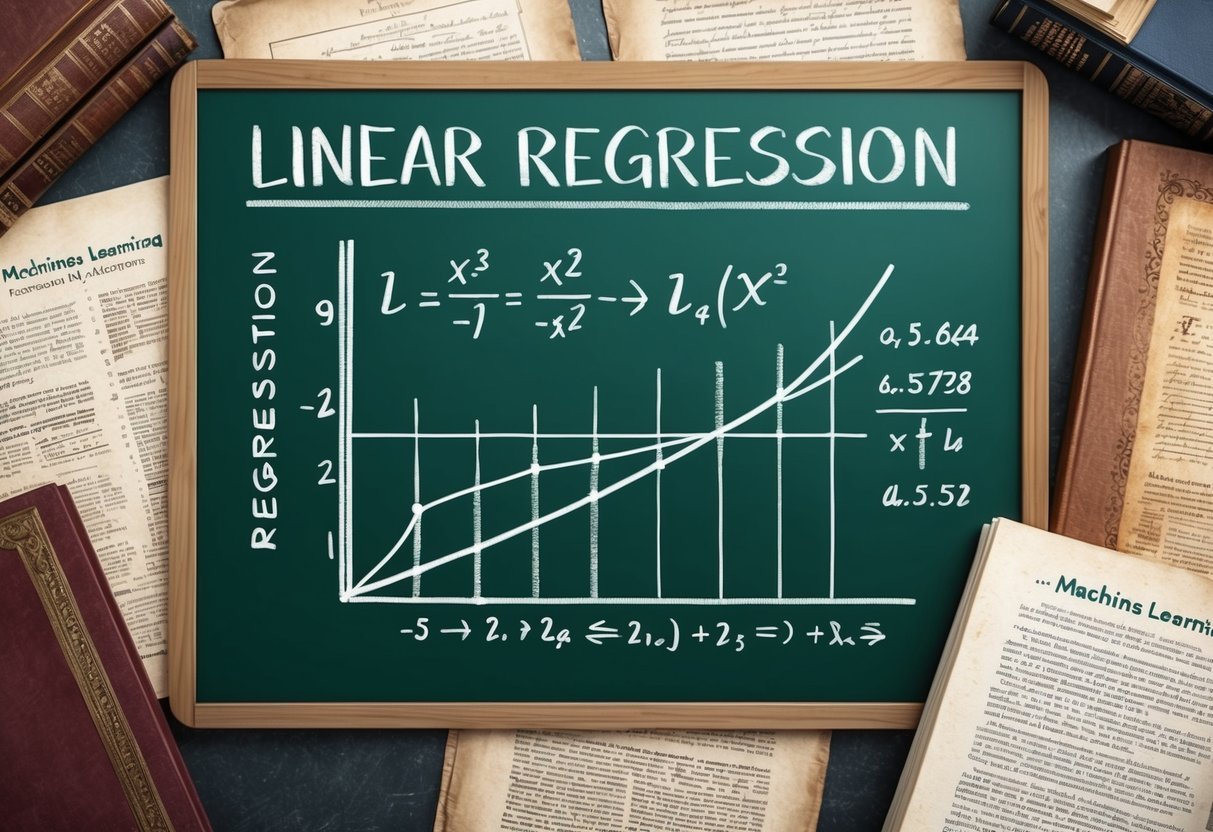
A chalkboard with equations and graphs depicting linear regression, surrounded by historical mathematical texts and tools

Linear regression relies on a combination of methods to establish a relationship between variables. Key aspects include the least squares method, cost functions, and gradient descent, each playing a crucial role in fine-tuning predictions and understanding data trends.

Understanding Least Squares Method

The least squares method is a foundational technique used in linear regression to minimize the differences between observed and predicted values. It involves finding the best-fit line by minimizing the sum of squared differences between data points and the line itself. This ensures that the line represents data trends as accurately as possible.

In practice, this means adjusting the slope and intercept of the line to reduce the overall error. The use of the least squares approach is critical in determining how well the line fits the data, facilitating accurate predictions. Its straightforward application has made it a core component of various statistical analyses.

Interpreting the Cost Function

The cost function, often represented as the mean squared error (MSE), evaluates how well a regression model predicts the data. It calculates the average of the squared differences between the actual and predicted values. The aim is to minimize this value to improve model accuracy.

A lower cost function value indicates a model that predicts data effectively. It is crucial in assessing model performance and guiding adjustments in model parameters. By continually refining the cost function, researchers and data analysts can enhance predictions, making it indispensable for accurate modeling.

Gradient Descent in Linear Regression

Gradient descent is an optimization algorithm that adjusts model parameters to minimize the cost function. By iteratively moving towards the steepest descent, it fine-tunes both the slope and intercept to achieve the lowest possible cost.

This process involves calculating the gradient (slope) of the cost function and updating parameters accordingly. It’s especially beneficial for large datasets where manual adjustments are impractical. Gradient descent uses a learning rate to determine step size, balancing between speed and accuracy. Through its use, linear regression models become more reliable and accurate, ensuring well-fitted results to the given data.

Extending to Multiple Variables

Expanding from simple to multiple linear regression allows for the modeling of relationships between one dependent variable and several independent variables. This approach improves the model’s predictive ability by incorporating more data points, allowing for nuanced insight.

Transition to Multiple Linear Regression

When moving from simple to multiple linear regression, the complexity increases as more independent variables are introduced to the model. In simple linear regression, the relationship between two variables is represented by a straight line. However, multiple linear regression uses a plane or hyperplane to fit the data. This process involves solving for coefficients that best describe the linear relationship between the combination of independent variables and the dependent variable.

Each coefficient in a multiple regression model represents the change in the dependent variable for a one-unit change in an independent variable, assuming other variables remain constant. This ability to account for the simultaneous influence of multiple factors makes multiple linear regression a cornerstone of statistical modeling and predictive analytics. By extending beyond a single dimension, it allows analysts to draw deeper insights and make more accurate predictions.

Handling Multiple Independent Variables

Incorporating multiple independent variables requires careful consideration of each variable’s significance to the model. Multivariate linear regression models can become complex due to interactions between variables. Therefore, ensuring that each variable contributes meaningfully is crucial. Analysts typically use statistical techniques like calculating correlation coefficients to understand these relationships before including them in a model.

Regularization methods, such as ridge regression and lasso, help manage multicollinearity by penalizing the size of coefficients, ensuring more stable and accurate models. Handling multiple variables involves balancing the complexity of the model with its predictive accuracy. Access to more data and computing power helps in efficiently analyzing large data sets with many variables. This enables detailed predictions and offers comprehensive insights across various fields like economics, biology, and machine learning.

Leveraging Statistical Principles

A chalkboard with equations and graphs depicting linear regression, surrounded by statistical textbooks and historical algorithm diagrams

Linear regression is a valuable tool in statistics, used to discover relationships between data points. By understanding regression analysis and correlations, one can make informed predictions and uncover patterns within the data.

Analyzing Data Points and Correlation

Data points can help in understanding the connection between different variables. Correlation measures the strength and direction of this connection. When examining data, it is crucial to determine how closely variables are related, as a strong or weak correlation can impact predictions.

A scatter plot visually represents this relationship by plotting data points on a graph. This visual can help identify trends or outliers. If data points align closely around a line, there is a strong correlation. Such analysis allows researchers to make predictions based on observed data patterns, emphasizing the importance of correlation in statistical models.

Importance of Regression Analysis

Regression analysis is key in understanding how one variable affects another within a dataset. It goes beyond simple correlation by providing a method to model relationships between variables. This can help in predicting outcomes or understanding the impact of changes in data.

In regression analysis, a line of best fit is determined, which minimizes the distance between data points and the line. This line provides a clear mathematical model of the relationship between variables. By using regression analysis, researchers can quantify the strength of these relationships, enhancing decision-making in various fields.

Refining Accuracy and Predictions

A chalkboard filled with equations and graphs, surrounded by books on statistics and computer science. A computer screen displaying a linear regression algorithm in action

Improving predictions in linear regression involves handling outliers and using techniques like regularization to optimize models. These strategies ensure better fitting to data while preventing overfitting.

Dealing with Outliers and Noise

Outliers can significantly impact the accuracy of a linear regression model. They may skew the best fit line, leading to incorrect predictions. Identifying and managing outliers is crucial. Techniques such as statistical tests can help detect these points.

Noise in data, which refers to random errors or variability, can also affect the model. Techniques like smoothing and filtering reduce noise. By addressing both outliers and noise, the model can provide more reliable results.

Optimization with Regularization Techniques

Regularization techniques help to prevent overfitting, a common issue where a model performs well on training data but poorly on unseen data. Ridge regression and lasso regression are popular methods used for this purpose.

Ridge regression adds a penalty to the loss function based on the square of the coefficients, helping to minimize extreme values. Lasso regression, on the other hand, uses the absolute value of coefficients, which can lead to some coefficients being zeroed out, effectively selecting the most important predictors.

Both techniques aim to refine the balance between fitting the training data and maintaining generalization for better predictions.

Practical Implementation in Machine Learning

A chalkboard with equations and graphs of linear regression, surrounded by historical documents and books on machine learning algorithms

Linear regression is a fundamental tool in machine learning for predicting continuous outcomes. Practical applications involve understanding its role within ML frameworks and applying techniques related to learning algorithms and learning rates.

Role of Linear Regression in ML

Linear regression is essential in machine learning as it helps predict values by modeling relationships between dependent and independent variables. It drives many practical applications like forecasting, resource estimation, and even financial modeling. The model seeks to establish a linear equation where a dependent variable is predicted from one or more independent variables.

A regression coefficient quantifies the strength and direction of this relationship. By using training data, the model learns these coefficients. The process of fitting a linear regression model in frameworks like Scikit Learn is straightforward, making it accessible and widely used.

Learning Algorithm and Learning Rate

The core of linear regression in practical machine learning hinges on the learning algorithm. Gradient descent is widely used, minimizing errors by iteratively updating model parameters. Adjustments are controlled by the learning rate, a critical parameter that decides how much to change the weights in response to the estimated error.

Choosing the right learning rate influences how quickly and accurately the model converges. A rate too high can overshoot the minimum error point, while a rate too low can result in a slow convergence. Thus, balancing this rate is crucial for achieving optimal regression coefficients and model performance. This iterative process is essential for efficient and effective model training.

Optimization Algorithms

A chalkboard filled with equations and graphs, surrounded by books on optimization algorithms and linear regression

Optimization algorithms play a crucial role in linear regression. They help find the best fit line by adjusting the model parameters. This section highlights the workings of gradient descent, its variations, and how loss functions and partial derivatives are used in optimization.

Gradient Descent Variants

Gradient descent is an optimization algorithm that minimizes the cost function by iteratively adjusting parameters. It calculates the partial derivative of the cost function concerning each parameter to determine the direction of movement. There are several variants of gradient descent.

  • Batch Gradient Descent: This uses the entire dataset to calculate the gradient. While accurate, it can be slow for large datasets.

  • Stochastic Gradient Descent (SGD): This algorithm uses one random data point per iteration. It is faster but less stable than batch gradient descent.

  • Mini-batch Gradient Descent: This combines batch and SGD by using a small subset of the dataset. It balances speed and accuracy efficiently, making it popular in practice.

These variants help tune the learning process and improve model performance.

Loss Functions and Partial Derivatives

A loss function measures how well a model’s predictions match actual outcomes. Common choices include the mean squared error for linear regression. The aim is to reduce this error by adjusting model parameters.

Partial derivatives are essential in this process. They indicate how changes in each parameter affect the loss function. Calculating these derivatives provides a direction to update model parameters to minimize loss.

Optimization algorithms use these derivatives to guide parameter updates. Ensuring the loss function value decreases after each iteration is key to training a model effectively. By iteratively using the gradient of the loss function, the algorithm finds a local minimum, optimizing the model.

Coding Linear Regression with Python

Python is widely used to implement linear regression due to its powerful libraries that simplify the process. Key components include using Python libraries like NumPy and SciPy to handle calculations and data manipulation efficiently.

Python Libraries for Linear Regression

Python offers a variety of libraries that make implementing linear regression straightforward and efficient.

NumPy is crucial for handling arrays and performing mathematical operations needed for regression. It supports multi-dimensional data and offers high-performance functionalities.

Additionally, Scikit-learn is a robust machine learning library built on NumPy. It is particularly popular for its ease of use and comprehensive tools for regression tasks.

Another useful library is Pandas, which assists in data manipulation and preparation, ensuring datasets are ready for analysis.

Together, these libraries create a powerful toolkit for building linear regression models in Python.

Python Implementation of a Regression Model

When implementing a regression model in Python, the first step is to prepare the data, typically using Pandas for data cleaning and organizing.

After data preparation, use Scikit-learn to split the data into training and testing sets.

The model is created using the LinearRegression class from Scikit-learn, which fits the training data.

Here’s a simple example:

from sklearn.model_selection import train_test_split
from sklearn.linear_model import LinearRegression
import pandas as pd

data = pd.read_csv("data.csv")
X = data[['feature1', 'feature2']]
y = data['target']

X_train, X_test, y_train, y_test = train_test_split(X, y, test_size=0.2, random_state=42)

model = LinearRegression()
model.fit(X_train, y_train)

This code snippet outlines how data can be prepared and fed into a linear regression model using Scikit-learn, which leverages the powerful capabilities of both NumPy and Pandas for efficient computation and data handling.

Advanced Linear Regression Models

Advanced linear regression models extend the basic linear regression to address more complex relationships and limitations. They often incorporate techniques like regularization and transformations to improve predictive accuracy and model performance.

Exploring Polynomial and Lasso Regression

Polynomial regression builds on linear regression by modeling the relationship between variables as an nth-degree polynomial. This approach captures non-linear patterns within the data, making it useful for datasets with curved trends.

Despite increasing the model’s flexibility, polynomial regression can risk overfitting, especially with high-degree polynomials.

Lasso regression, or Least Absolute Shrinkage and Selection Operator, adds regularization to the mix. It introduces a penalty on the coefficients of the variables, effectively shrinking some to zero.

This helps in feature selection, making the model easier to interpret while reducing the risk of overfitting.

Lasso regression can result in sparse models, retaining only the most significant variables, thus improving the model’s predictive power.

Insight into Ridge Regression

Ridge regression, another regularization technique, addresses issues such as multicollinearity. It adds a penalty equal to the square of the magnitude of coefficients to the cost function.

This technique helps by shrinking the coefficients but not necessarily setting any to zero.

The primary benefit of ridge regression is its ability to handle multicollinearity, which occurs when independent variables are highly correlated. It stabilizes the estimates and often enhances the predictive accuracy.

While ridge regression won’t simplify the model as Lasso does, it is valuable in scenarios where all predictors can offer some meaningful insights. This makes it well-suited for datasets with many variables contributing to the final predictive model.

Evaluating Model Performance

In evaluating linear regression models, understanding key metrics like the Residual Sum of Squares (RSS) and R Squared is vital. These metrics help determine how well a model fits the data and predict future outcomes.

Additionally, using error metrics ensures the reliability and validity of the model.

Understanding Residual Sum of Squares and R Squared

Residual Sum of Squares (RSS) measures the variation of data not explained by the model. Smaller RSS values suggest a better fit, implying the model accurately captures the data’s trends. In contrast, larger RSS indicates inadequacies in the model’s predictions.

R Squared, or the coefficient of determination, gauges how well model parameters predict actual outcomes by showing the proportion of variance explained.

An R Squared value close to 1 means a strong relationship between the predictors and the response variable, signaling effective model performance.

It’s important for practitioners to understand these measures which assess the quality and fitting of regression models accurately. Evaluating both RSS and R Squared provides a complete picture of a model’s capability.

Error Metrics and Model Validation

Error metrics such as Root Mean Squared Error (RMSE) and others are crucial in regression analysis. RMSE provides the average magnitude of prediction errors, serving as a gauge for model accuracy.

Lower RMSE signifies a more precise model.

These metrics are essential parts of model validation, which ensures models perform well under different conditions.

Validation involves comparing predicted results with actual data, checking if the model reliably captures trends without overfitting.

Using metrics like RMSE alongside validation techniques helps refine models for real-world applications. Proper validation establishes trust in model forecasts and parameter accuracy, ensuring robust decision-making in various fields.

Frequently Asked Questions

A chalkboard with a graph showing the progression of linear regression algorithm history, surrounded by books and research papers

Linear regression is an essential tool in machine learning, known for its ability to model relationships between variables. Here, you’ll find answers to common questions about its components, examples, variations, implementation steps, historical evolution, and significance.

What are the key components of a linear regression model in machine learning?

A linear regression model in machine learning primarily consists of variables—dependent and independent—the coefficients, and the intercept. The model predicts the dependent variable using the independent variables.

The model’s effectiveness is measured by its ability to minimize the distance between actual and predicted values.

Can you provide an example to explain how linear regression works?

Consider a dataset of students’ study hours and their corresponding test scores. By applying linear regression, a line of best fit can be drawn. This line helps predict a student’s test score based on their study hours.

The closer the data points are to this line, the more accurate the prediction.

How does multiple linear regression differ from simple linear regression?

Simple linear regression examines the relationship between two variables: one dependent and one independent. In contrast, multiple linear regression involves more than one independent variable.

This allows for modeling more complex relationships, as multiple factors are taken into account when predicting the outcome.

What are the main steps involved in implementing a linear regression algorithm?

Implementing a linear regression algorithm involves several key steps.

First, gather and prepare the dataset. Next, split the data into training and testing sets. Then, an algorithm calculates the best-fitting line.

Finally, the model’s accuracy is validated using error metrics like mean squared error.

How has linear regression evolved since its inception?

Linear regression has evolved significantly, from basic statistical applications to becoming integral in sophisticated machine learning models. Initially used for simple predictions, it now serves as a building block for complex algorithms and techniques in various fields such as finance, biology, and social sciences.

Why is linear regression considered crucial in predictive modeling?

Linear regression is crucial because of its simplicity, efficiency, and interpretability. It provides clear insights into data relationships, making it easier to understand and explain predictions.

This attribute makes it a preferred choice for many predictive modeling applications, especially when quick and straightforward predictions are needed.

Categories
Uncategorized

Learning Decision Tree History and Terminology: A Comprehensive Overview

Origins and Evolution of Decision Trees

A tree growing from roots, with branches representing decision nodes and leaves as outcomes, surrounded by historical documents on decision tree terminology

Decision trees have been used for making decisions and predictions since the early days of recorded history. They have evolved significantly with the introduction of algorithms like ID3, C4.5, and CART, which improved their accuracy and efficiency.

Early Development and Pioneering Algorithms

The roots of decision trees can be traced back to early methods of management and decision-making practices. One of the pivotal moments in their development was the introduction of the ID3 algorithm by J. Ross Quinlan in the 1960s.

ID3 uses an information-based approach to create decision trees, which marked a significant step forward in machine learning techniques.

Following ID3, Quinlan introduced another influential algorithm, C4.5, which further refined the process of tree construction by handling both categorical and continuous data more effectively. C4.5 improved the robustness and usability of decision trees, making them more applicable to real-world problems.

Improvements and Variations Over Time

As decision trees gained popularity, several enhancements and variations were developed. One significant improvement was the development of the CART (Classification and Regression Trees) algorithm.

CART, introduced in the 1980s, allowed for both classification and regression tasks, making it versatile in various applications.

Other methods, like CHAID (Chi-square Automatic Interaction Detector), focused on identifying relationships between variables using statistical techniques such as the chi-square test. This made CHAID useful for market research and social science studies.

Fundamental Concepts in Decision Trees

A branching tree with labeled nodes representing fundamental concepts in decision tree learning

Decision trees are versatile tools used in machine learning for decision-making and prediction tasks. They operate through a tree-like model featuring different nodes representing decisions or outcomes.

Defining Decision Trees and Their Components

A decision tree is a flowchart-like model with a root node at the top. This node represents the initial question or decision. Each possible outcome leads to either a decision node or a leaf node.

Decision nodes, often called internal nodes, present further questions or decisions based on previous answers. Leaf nodes show the final outcome or decision and are located at the tree’s ends.

The tree splits based on different attributes, creating branches that help in sorting out data. Understanding each component helps in recognizing how decisions are made and predictions are calculated.

Mastery of these fundamental elements forms the backbone of decision tree analysis.

Classification and Regression Trees

Decision trees can be divided into two main types: classification trees and regression trees.

Classification trees are used when the outcome is categorical, such as determining if an email is spam or not. They work by splitting data into groups based on shared characteristics, aiming to categorize data points accurately.

Regression trees, on the other hand, deal with continuous outcomes. They predict values based on input features, like estimating house prices based on location and size.

Each type of tree uses similar principles but applies them to different types of data, making them adaptable and powerful tools in various fields.

Building Blocks of Decision Trees

A tree with branches labeled "history" and "terminology" grows from a pile of building blocks

Decision trees are powerful tools in machine learning, comprised of elements like nodes and attributes that structure decision paths. They accommodate a variety of variable types and use specific features to segment data for predictive analysis.

Nodes and Splits in Decision Trees

In decision trees, nodes form the core components. A parent node is where a decision starts, and it splits into child nodes based on certain conditions. Each node can represent a question or decision based on specific features or attributes of the data.

When a node cannot be split further, it becomes a leaf node, representing a final decision or outcome. Leaf nodes are crucial, as they determine the classification or prediction made by the tree.

The process of splitting nodes involves evaluating the best feature to divide the data, ensuring that each resulting group (child node) is purer than the parent.

Types of Variables and Attributes

Decision trees handle various variable types, including categorical variables (e.g., color or brand) and continuous ones (e.g., age or height).

Categorical variables are often transformed into binary splits. This conversion helps the tree manage different data types effectively, maintaining decision accuracy.

Attributes, or features, are characteristics of the data that guide the decision process. Selecting the right attributes is crucial, as they define how effectively the tree predicts outcomes.

Trees use features to establish criteria for node splits, leading to refined groups that aid in accurate prediction models.

Algorithmic Approaches to Decision Trees

A branching tree with nodes representing decision history and terminology

Decision trees are powerful tools in machine learning that rely on algorithmic methods for building and interpreting data hierarchies. These algorithms often balance simplicity with detailed analysis to effectively classify information.

Common strategies involve using specific criteria to decide how to split data, enhancing the model’s accuracy.

ID3, C4.5, and CART Algorithms

ID3, C4.5, and CART are three popular algorithms used for generating decision trees.

ID3 (Iterative Dichotomiser 3) was developed by Ross Quinlan and utilizes a heuristic based on information gain. It selects the attribute that results in the highest information gain as the root node for splitting the data.

C4.5 builds upon ID3 by handling continuous attributes, missing values, and pruning trees to prevent overfitting. It also uses gain ratio, an improvement over information gain, to select attributes.

CART (Classification and Regression Trees), introduced by Breiman et al., supports both classification and regression tasks. CART uses binary trees and employs Gini impurity as a splitting metric, focusing on creating subsets that are as pure as possible.

Entropy, Information Gain, and Gini Impurity

These concepts are crucial in determining how data is split in a decision tree.

Entropy measures the level of disorder or uncertainty in data. Low entropy means data is homogeneous, while high entropy indicates diversity.

Information gain quantifies the reduction in entropy after a dataset is split on a particular attribute. It helps identify the most informative features in data. The greater the information gain, the better the attribute for splitting.

Gini impurity is another metric used for deciding splits, particularly in the CART algorithm. It calculates the probability of incorrectly classifying a randomly chosen element, aiming for low impurity in resulting subsets. This makes decision tree construction more effective in classification tasks.

Training Decision Trees

A tree with branches representing different decision paths, surrounded by historical documents and learning materials

Training decision trees involves choosing how to split data at each node to make accurate predictions. It also requires managing overfitting, which may occur when the tree becomes too complex.

These tasks are handled by selecting appropriate splitting criteria and applying pruning techniques.

Splitting Criteria and Determining Best Splits

Choosing the right splitting criteria is crucial for building an effective decision tree.

Splitting involves dividing a dataset into smaller groups, which helps improve predictive accuracy. Two popular criteria used for this purpose are the Gini index and variance reduction.

The Gini index measures the impurity of a dataset. When splitting a node, the tree aims to reduce this impurity, thus enhancing prediction precision. Lower Gini index values indicate better, purer splits. This method is typically used in classification tasks where the goal is to place similar items together.

Variance reduction, on the other hand, is more relevant to regression tasks. It calculates how much variance in the target variable can be reduced by a potential split. A good split leads to smaller subgroups with lower variance, resulting in accurate predictions. Both methods are essential for determining the most effective splits in a tree.

Handling Overfitting Through Pruning

Overfitting happens when a decision tree becomes too tailored to the training data, capturing noise rather than the actual pattern. Pruning is a technique used to reduce overfitting.

Pruning involves trimming branches that have little predictive power.

Pre-pruning stops tree growth early if a split does not significantly improve predictions. Post-pruning involves removing branches from a fully grown tree based on how well they perform on validation data.

These methods ensure the tree generalizes well to new data. By preventing overfitting, pruning helps maintain a balance between complexity and prediction accuracy, ensuring the tree’s effectiveness on unseen datasets.

Measuring Decision Tree Performance

A decision tree branching out with labeled nodes and branches, surrounded by historical references and terminology

Measuring the performance of decision trees involves evaluating various metrics and analyzing errors. By assessing these factors, one can improve model accuracy and effectiveness in machine learning tasks.

Common Metrics and Performance Indicators

In decision tree analysis, several important metrics are used to gauge performance.

Accuracy reflects the percentage of correct predictions made by the model. It’s important for understanding the model’s effectiveness overall.

Another metric is precision, which measures the proportion of true positive results in relation to the total predicted positives.

Recall evaluates how well the tree identifies true positives from all actual positives. F1 score balances precision and recall, offering a composite metric useful when classes are imbalanced.

Apart from these, the confusion matrix provides an in-depth view of classification performance, detailing true positives, false positives, true negatives, and false negatives.

These metrics help in identifying the strengths and weaknesses of the decision tree model.

Error Analysis and Model Tuning

Error analysis is crucial in refining decision tree models. By examining bias and variance, one can understand the types of errors affecting the model’s performance.

Bias refers to errors due to overly simplistic assumptions, while variance considers errors from too much complexity.

Model tuning involves adjusting hyperparameters such as maximum depth, minimum samples per leaf, and criterion for splitting.

Effective tuning reduces errors and enhances model accuracy. Techniques like cross-validation can help in evaluating model stability and performance.

Through meticulous error analysis and hyperparameter tuning, decision trees can be optimized for better performance in machine learning tasks.

Ensemble Methods and Decision Trees

Ensemble methods combine multiple models to improve prediction accuracy. Using decision trees, various strategies have been developed to enhance their performance. These include techniques like Random Forests, Bagging, and Boosting.

Random Forest and Bagging

Random Forest is a robust ensemble method that creates a “forest” of decision trees. Each tree is trained on a random subset of the training data by using a technique called Bagging.

Bagging, short for Bootstrap Aggregating, helps in reducing the variance of the model. It involves sampling the training data with replacement and training each tree on a different sample.

The Random Forest algorithm averages the predictions from each tree to make a final decision. This process reduces overfitting, which is a common problem with individual decision trees.

Additionally, Random Forests are effective in handling large datasets and noisy data, making them widely used. You can learn more about this technique through ensemble methods based on decision trees.

Boosting and Advanced Ensemble Techniques

Boosting is another powerful ensemble technique that improves model accuracy. Unlike Bagging, Boosting focuses on correcting the errors from prior models.

It builds trees sequentially, where each tree tries to fix errors made by the previous ones. This results in a strong predictive model by blending the strengths of all the trees.

Advanced methods like XGBoost have gained popularity for their speed and performance.

XGBoost stands out due to its regularization feature, which helps prevent overfitting. It has been particularly successful in data science competitions. By prioritizing the most important mistakes, these models are tailored for high accuracy and efficiency in complex datasets.

Practical Applications of Decision Trees

A decision tree branching from historical roots, with key terminology as leaves, symbolizing practical applications

Decision trees are versatile tools used in various fields to aid in decision-making and data analysis. They provide intuitive models that can be easily interpreted, making them valuable in industries such as healthcare and marketing.

Decision Trees in Healthcare

In healthcare, decision trees play a crucial role by helping professionals make informed decisions about patient care.

They are used to diagnose diseases by analyzing patient data such as symptoms, medical history, and test results.

This approach assists doctors in choosing the best treatment pathways.

Another significant use is in predicting patient outcomes.

For example, decision trees can assess the risk of complications after surgery, allowing medical teams to take preventative measures.

By providing clear, understandable models, decision trees help enhance the decision-making process in medical settings.

Marketing and Customer Analysis

In marketing, decision trees help analyze consumer data to find patterns in buying behavior and preferences.

Businesses can segment customers based on characteristics like age, location, and purchase history, allowing for targeted marketing strategies.

Decision trees also enhance sentiment analysis. They evaluate customer feedback, reviews, and social media posts to gauge public opinion on products or services.

By understanding customer sentiments, companies can refine their marketing approaches and improve customer satisfaction.

Moreover, decision trees support predicting customer churn, which is vital for retaining clients.

They help identify factors leading to customer loss and develop strategies to enhance retention.

With clear and digestible data insights, decision trees enable marketers to make informed decisions that drive business success.

Decision Trees in Modern Machine Learning

Decision trees are a powerful tool in machine learning.

They offer clear visualization and logical decision paths. These features make decision trees widely used in both data analysis and practical applications.

Integration with Other Machine Learning Algorithms

Decision trees can be combined with other algorithms to improve performance and robustness.

When used with ensemble methods like Random Forests and Gradient Boosting, decision trees provide a strong basis for creating robust models.

These ensemble techniques rely on multiple decision trees to minimize errors and improve prediction accuracy.

For instance, Random Forests combine several trees to average their predictions, which reduces overfitting and increases reliability.

In addition, decision trees are often used in combination with feature selection methods to identify the most important variables in a dataset.

This integration helps in refining models and ensures that only relevant data features influence predictions. This leads to models that are not only accurate but also efficient.

The Role of Decision Trees in Data Mining

In data mining, decision trees serve as a fundamental tool for discovering patterns and relationships in data.

Their flowchart-like structure enables easy interpretation and visualization of decision rules, which is a key advantage in extracting actionable insights from large datasets. This simplicity makes them ideal for both classification and regression tasks.

Decision trees are particularly valued for their ability to handle varied data types and manage missing values effectively.

They offer a straightforward approach to classifying complex data, making them a staple in data mining applications.

By understanding patterns through decision tree algorithms, organizations can gain meaningful insights into their business processes, leading to informed decisions.

Software and Tools for Decision Trees

A computer screen displaying decision tree software with various tools and historical references

Several software tools are available for building decision trees, offering unique features tailored to specific needs.

Popular choices include Scikit-Learn for Python enthusiasts and options for those working in Matlab, providing a comprehensive suite for creating and analyzing decision trees.

Scikit-Learn’s DecisionTreeClassifier

Scikit-Learn is a robust Python library that includes the DecisionTreeClassifier, ideal for classification tasks.

It is known for its simplicity and efficiency. Users appreciate its intuitive API, which makes it easy to fit, prune, and visualize decision trees.

The DecisionTreeClassifier uses various criteria like Gini impurity or entropy for splitting data points, allowing flexibility in model building.

Scikit-Learn supports handling missing values and scaling with large datasets, which is crucial for real-world applications.

Its ability to integrate with other libraries such as NumPy and Pandas enhances data manipulation and preprocessing.

Additionally, Scikit-Learn’s comprehensive documentation and strong community support make it a preferred choice for both beginners and advanced users.

Decision Trees Implementation in Python and Matlab

Python and Matlab provide distinct environments for implementing decision trees.

Python, with libraries like Scikit-Learn, offers versatile tools for machine learning, including capabilities to visualize and tweak models to optimize performance.

Meanwhile, Matlab features built-in functions for decision tree algorithms like fitctree for classification and fitrtree for regression tasks.

Matlab is praised for its interactive environment, allowing users to experiment with parameters and instantly see results in graphical form. This can be advantageous for those who prefer a visual approach.

On the other hand, Python’s extensive ecosystem, including Jupyter notebooks, facilitates exploratory data analysis and seamless integration with other machine learning projects.

Both options have their strengths, making them valuable depending on the project’s requirements and user preference.

Advanced Topics in Decision Trees

A branching tree with nodes labeled "history" and "terminology."

In decision tree analysis, understanding how trees’ characteristics affect prediction quality is crucial. Key ideas like homogeneity and strategies for handling multiple outputs can significantly boost a model’s performance.

Homogeneity, Purity, and Diversity in Trees

Homogeneity refers to how similar the data points within the tree’s leaves are regarding the target variable. Higher homogeneity in a leaf often means more accurate predictions. This is because the data points in the leaves are more alike, which simplifies predicting the target.

Purity, closely related to homogeneity, measures how uniform the data is within a node. Common metrics for assessing purity include the Gini index and entropy. A split creating pure branches usually means better classification performance, making purity a critical aspect of tree construction.

Diversity within a decision tree relates to the variety found in different branches. While less discussed than homogeneity, diversity can impact how well a tree generalizes unseen data. A tree that is too homogeneous might overfit, so balancing these aspects is essential for robust model performance.

Strategies for Multi-Output Decision Trees

Multi-output decision trees handle scenarios where predictions involve several target variables simultaneously.

These trees need distinct strategies compared to single-output trees since they manage multiple outputs per instance. Typically, each sub-tree in the model is designed to address different targets.

An effective strategy is to structure the tree so that it learns shared representations for targets, aiming to improve prediction efficiency.

This often means optimizing how splits are carried out to maximize the performance across all outputs instead of treating them separately.

Leveraging ensemble methods like bagging or boosting can also enhance multi-output trees.

These methods can combine predictions from different sub-trees to improve accuracy collectively. This approach captures broader patterns in data distribution, which aids in managing the complexity seen in multi-output tasks.

Frequently Asked Questions

A tree with branches representing different historical terms and concepts related to learning decision trees

Decision trees are an essential tool in machine learning, offering a way to visually and logically analyze data. They come from a rich history and involve various terms and components that shape their use in decision-making and classification tasks.

What are the origins and developments in the history of decision tree algorithms?

Decision trees have a long history in computing, with early algorithms dating back to the 1960s. The ID3 algorithm by J. Ross Quinlan was one of the first to use an information-based approach, marking a significant development in the field.

What are the key terminologies and components in a decision tree?

Key components of a decision tree include nodes, branches, and leaves. Nodes represent decision points, branches indicate different choices, and leaves show final outcomes. Terms like bagging and boosting also arise when discussing extensions of decision tree methods in machine learning.

How do decision trees function in machine learning and classification tasks?

In machine learning, decision trees classify data by splitting it based on certain features. These splits form a tree-like model that can be used to make predictions and solve classification and regression problems effectively. The decision tree model builds logic by examining each feature one at a time, narrowing down the data.

What are some common examples demonstrating the application of decision tree algorithms?

Decision tree algorithms are widely used in various applications like customer relationship management, credit scoring, and medical diagnosis. They help in breaking down complex decisions into simpler, more manageable parts, allowing businesses and professionals to derive insights quickly and efficiently.

How does a decision tree algorithm select the best attributes for splitting the data?

A decision tree selects the best attributes for splitting data by evaluating each feature on how well it separates the data based on a certain criterion. Common criteria include Gain Ratio and Gini Index. The aim is to increase the purity of the subset, effectively categorizing data into useful groups.

What are the different methods used to prevent overfitting in decision tree learning?

Preventing overfitting in decision trees can be achieved through techniques like pruning, which removes unnecessary nodes, and setting a maximum depth for the tree.

It’s also useful to use cross-validation to ensure the model generalizes well to new data.

These efforts help in creating more robust models that perform well under different conditions.

Categories
Uncategorized

Learning about Support Vector Machines: A Guide to Classification and Regression Techniques

Fundamentals of Support Vector Machines

Support Vector Machines (SVMs) are essential in both classification and regression tasks in machine learning. They work by finding a hyperplane that separates data into different classes with the widest possible margin.

Definition and Core Concepts

A Support Vector Machine is a supervised learning model used for classification and regression. It seeks to identify the best hyperplane that can divide a dataset into classes.

The hyperplane chosen is the one with the largest margin, which maximizes the separation between different classes.

The data points that lie closest to this hyperplane are called support vectors. These support vectors are crucial because they determine the hyperplane’s position and orientation.

By maximizing the margin, SVMs aim to increase the model’s robustness to new and unseen data. This makes it particularly useful for classification tasks, as it ensures that the classes are well separated.

History and Evolution of SVMs

Initially developed in the 1960s, Support Vector Machines gained significant popularity in the 1990s when Vladimir Vapnik and his collaborators introduced them to the machine learning community. SVMs represented a major breakthrough in classification algorithms.

The algorithm was particularly successful because it provided a new way to approach problems involving high-dimensional spaces.

Over the years, SVMs have evolved with the use of different kernel techniques, which allow them to handle non-linear classification problems by transforming data into higher dimensions where it is linearly separable.

Today, SVMs continue to be a vital component of machine learning toolkits, valued for their efficiency and accuracy in a wide range of applications.

Mathematical Principles Behind SVM

Support Vector Machines (SVM) use mathematical concepts to classify data effectively. By understanding how hyperplanes and margins work, along with how linearly separable data is analyzed, one can appreciate the robust nature of SVM.

Hyperplane and Margin Concepts

In SVM, a hyperplane is a decision boundary that separates data into different classes. For two-dimensional data, this is a line, but for higher dimensions, it acts as a flat subspace.

Finding the optimal hyperplane is crucial. This involves maximizing the margin, which is the gap between the hyperplane and the nearest points from either class, known as support vectors.

Mathematically, the key to this optimization involves the dot product. This helps determine distances from the hyperplane, crucial for maximizing the margin.

Lagrange multipliers are used to solve this optimization problem, ensuring the widest margin without misclassifying the data points.

Linearly Separable Data Analysis

When dealing with linearly separable data, SVM aims to find a hyperplane that perfectly divides the classes. This means there’s a straight line or flat plane in higher dimensions that can separate the data points into their respective categories with no overlaps.

In these cases, SVM guarantees that the data points are correctly categorized.

The process is mathematical, involving the dot product to ascertain the position of points relative to the hyperplane. Lagrange multipliers play a crucial role here, allowing SVM to flexibly adjust the position of the hyperplane to accommodate the varying distributions of data. This precision makes SVM a powerful tool for straightforward classification challenges.

SVM for Classification and Regression

Support Vector Machines (SVMs) are versatile tools used in machine learning for both classification and regression tasks. They help categorize datasets in binary or multiple classes and predict continuous values effectively.

Binary and Multiclass Classification

SVMs are well-suited for binary classification, where the goal is to separate data into two distinct classes. The algorithm finds an optimal line or hyperplane that maximizes the margin between different classes. This leads to better generalization and more accurate predictions.

In multiclass classification, SVMs extend their capabilities to handle more than two classes. This is typically achieved using strategies like one-vs-one or one-vs-all. Each approach breaks down the task into multiple binary classification problems.

This adaptability makes SVMs widely used in various applications, such as text and image classification.

Support Vector Regression Explained

Support Vector Regression (SVR) is a variation of SVM that caters to regression problems where the output is continuous rather than categorical. SVR uses a similar approach to that of classification SVMs by creating a hyperplane that best fits the data points.

It aims to find a function that deviates from actual data points by a value less than a threshold, ensuring the model’s robustness.

The flexibility of SVR makes it effective in high-dimensional spaces, allowing it to handle cases where conventional regression techniques might falter. It’s especially useful in fields like financial forecasting and biological data analysis, where precision is crucial.

Kernel Methods in SVM

Support Vector Machines (SVM) use kernel methods to solve complex problems that are not linearly separable. The kernel trick helps map data into a higher-dimensional space, allowing SVM to perform better. Various kernel functions like linear, polynomial, and radial basis function (RBF) kernels, each help handle different data complexities and patterns.

Understanding Kernel Trick

The kernel trick is a technique used to transform data into a higher-dimensional space without explicit computation. It allows SVMs to find a linear boundary in this space, making it easier to separate complex datasets.

This approach avoids the computational cost of performing transformations directly because kernel functions calculate relationships between data points efficiently using mathematical shortcuts.

Using the kernel trick, SVM can handle non-linearly separable data by exploiting mathematical properties of kernel functions. This enables the model to create decision boundaries that align with the original data’s structure, supporting effective classification and regression tasks in various applications.

Types of Kernel Functions

Each kernel function caters to different types of data patterns.

The linear kernel is the simplest, used for linearly separable data by keeping transformations minimal. This kernel calculates the dot product of feature vectors to identify decision boundaries.

For more complex data, the polynomial kernel provides flexibility by incorporating polynomial degrees. It helps map data into higher dimensions, improving separation where simple linear boundaries fail.

The radial basis function (RBF) kernel is known for its versatility. It utilizes Gaussian functions to focus on clusters of data points, adapting well to many structures and patterns. This makes RBF suitable for datasets requiring intricate decision surfaces.

Implementing SVMs with Python Libraries

Support Vector Machines (SVMs) are a popular choice for classification and regression tasks in Python. Using libraries like Scikit-learn simplifies their implementation. This section explores key modules in Scikit-learn for SVMs and provides code examples and tutorials for effective usage.

SVM Modules in Scikit-learn

Scikit-learn is a powerful library that supports various machine learning algorithms. For SVMs, it includes modules like SVC (Support Vector Classification) in the svm package. SVC is used for classification tasks by finding the best hyperplane that separates classes in the feature space. The SVR module, on the other hand, handles regression tasks using SVMs.

Scikit-learn’s modules are praised for their simplicity and efficiency. They offer a straightforward API, making them accessible to beginners and experienced developers alike.

Available parameters let users modify elements like the kernel type, regularization, and polynomial degree, offering flexibility to tailor the SVM model to specific needs.

Python Code Examples and Tutorials

Learning how to implement SVMs with Python is enhanced by access to detailed tutorials and code examples. Many online resources provide step-by-step guides for deploying SVMs through Scikit-learn.

These tutorials walk users through initializing an SVM, fitting it with data, and evaluating its performance.

For example, a tutorial on Scikit-learn’s website explains how to use SVC for classification tasks. Another resource at GeeksforGeeks offers practical code snippets for classifying data with SVMs.

These guides help users grasp the practical application of SVM in real-world datasets, making the learning experience comprehensive and engaging.

Optimization and Regularization

Optimization and regularization are key aspects of Support Vector Machines (SVMs). They help in balancing the complexity of the model with the need to generalize well on unseen data. This involves managing the margin and tuning the parameters to achieve optimal performance.

Soft Margin Classification

In many real-world scenarios, data is often not perfectly separable by a straight line. Soft margin classification addresses this by allowing some misclassification. This approach finds a balance between maximizing the margin and minimizing classification errors.

The soft margin is controlled by the regularization parameter, often referred to as the C parameter.

The C parameter determines the trade-off between a wider margin and fewer misclassified samples. A large C value will encourage the model to classify all training points correctly, which may lead to overfitting. A small C value allows a larger margin with some points being misclassified, promoting better generalization.

This approach effectively manages the dual problem of accuracy versus simplicity in model predictions.

Regularization Parameter Tuning

Regularization is crucial in preventing an SVM model from fitting noise in the data, which can lead to overfitting. The C parameter acts as the regularization parameter, controlling the penalty for misclassified points.

Tuning this parameter is essential to find the optimal balance between fitting the training data well and maintaining model simplicity.

Parameter tuning can be done using techniques like cross-validation. This method evaluates various C values to identify the one that yields the best performance on unseen data.

Proper tuning ensures that the model is neither too complex nor too simplistic, enabling robust predictions on new datasets. Regularization helps manage the trade-off between bias and variance, making the model well-suited for different classification tasks.

Performance Evaluation Metrics

Evaluating the performance of Support Vector Machines (SVM) involves several important metrics and techniques. These metrics include accuracy, precision, and recall, while validation methods help in assessing the model’s effectiveness.

Accuracy, Precision, and Recall

Accuracy measures how many predictions made by the SVM are correct. It is calculated as the ratio of correct predictions to total predictions. However, relying solely on accuracy can be misleading in imbalanced datasets.

Precision indicates the accuracy of positive predictions. It is the ratio of true positive outcomes to the total positive predictions, helping to evaluate the relevance of the positive class.

Recall shows how many actual positives were correctly identified. It is the number of true positives divided by the sum of true positives and false negatives.

Balancing both precision and recall is crucial, as focusing on one may negatively impact the other. Using a balanced approach is recommended for skewed data distributions.

Validation and Cross-Validation Techniques

Validation techniques help in assessing how the SVM model performs on unseen data.

One common approach is cross-validation, a method that divides the dataset into several subsets or “folds.” During cross-validation, training occurs on some folds while testing is done on the remaining fold.

This rotation helps in determining the model’s robustness and reduces overfitting by providing insights into how it generalizes to new data.

Cross-validation is especially useful when the available data is limited, providing a more reliable performance evaluation than a single train-test split.

Advanced SVM Techniques

Support Vector Machines (SVMs) can handle complex datasets and are particularly effective in non-linear and high-dimensional scenarios.

These advanced techniques make SVMs versatile for applications in fields like image and text classification as well as gene expression analysis.

Non-Linear SVMs and Their Applications

Non-linear SVMs excel in handling data where a straight line cannot separate classes effectively. They achieve this through kernel functions, which allow for the mapping of data into a higher-dimensional space.

Popular kernel types include polynomial, radial basis function (RBF), and sigmoid.

For instance, in image classification, non-linear SVMs can distinguish between objects by transforming pixel data into a feature space where various classes become linearly separable.

Similarly, for text classification, these models can process complex patterns in word frequency distributions, making it easier to distinguish between spam and non-spam emails or categorize news articles.

Gene expression analysis also benefits from non-linear SVMs. Genes, often expressed in non-linear patterns, can be grouped effectively for research in areas like cancer detection. By analyzing gene patterns, non-linear SVMs aid in understanding complex biological processes and developing diagnostic tools.

Strategies for High-Dimensional Data

High-dimensional data, common in fields such as bioinformatics and natural language processing, presents unique challenges.

SVMs are well-suited for these situations due to their robustness in handling large feature spaces.

Feature selection and dimensionality reduction are critical strategies to optimize SVMs for such data.

Principal Component Analysis (PCA) and other dimensionality reduction techniques help in reducing feature count while retaining essential information. This is important in gene expression analysis, where each gene represents a dimension, making direct analysis inefficient.

In text classification, strategies often involve reducing the vocabulary size using techniques like term frequency-inverse document frequency (TF-IDF). These methods ensure SVMs remain efficient and effective, even when data points have thousands of attributes.

Dealing with Practical Challenges

A person studying a complex diagram of Support Vector Machines, surrounded by books and computer screens

Support Vector Machines (SVMs) face several practical challenges that affect their performance. Two significant areas of focus are handling outliers and ensuring that data is properly scaled and prepared before implementation.

Outlier Detection and Noise Handling

Outliers can influence the performance of SVMs by shifting the decision boundary, leading to inaccurate predictions. Detecting these outliers is crucial to maintain model accuracy.

Methods such as using a robust version of SVMs can help minimize the impact of noise. These versions adjust their algorithms to be less sensitive to extreme values.

Supporting outlier detection, certain techniques, like using a soft margin, allow some misclassifications intentionally. This approach makes SVMs more flexible in handling noisy data.

Implementing cross-validation can also aid in identifying outliers by evaluating model performance on different data splits.

Feature Scaling and Data Preparation

Proper data scaling is a key step in the successful application of SVMs. Since SVMs rely on distance-based calculations, inconsistent data scales can skew results.

Feature scaling methods, such as standardization and normalization, ensure that each feature contributes equally to the distance calculations.

Data preparation also involves dealing with different data structures and managing sparsity.

Sparse solutions help SVMs to effectively manage large datasets by focusing only on important data points. This not only speeds up computation but also enhances model efficiency, especially when dealing with high-dimensional data.

Implementing these techniques ensures that SVMs can handle complex datasets with precision.

Use Cases and Real-World Applications

Support Vector Machines (SVMs) are widely used in various fields for their effectiveness in classification tasks. They excel in areas like bioinformatics and image processing, handling complex datasets with high accuracy.

Applications in Bioinformatics

In bioinformatics, SVMs are pivotal in analyzing biological data. One common application is in gene expression analysis, where SVMs help identify cancerous gene patterns.

These models effectively classify complex and high-dimensional data, a common characteristic of biological datasets.

SVMs are also used in protein classification, predicting the function of unknown proteins. They analyze large amounts of genomic and proteomic data, providing insights into biological processes.

The application of SVMs in bioinformatics continues to expand, enhancing the ability to process and interpret complex biological data accurately.

Case Studies: Image and Spam Detection

SVMs are instrumental in image classification and spam detection tasks.

In image classification, SVMs are used to distinguish between different categories of images like those in handwriting recognition. They excel in dealing with high-dimensional spaces, crucial for this type of task.

For spam detection, SVMs classify email content efficiently, separating spam from non-spam messages. They adapt well to varied datasets, making them a reliable choice for classifiers in this domain.

These real-world applications demonstrate the versatility of SVMs in tackling complex classification problems across different fields.

Frequently Asked Questions

Support Vector Machines (SVMs) are popular in machine learning for their effectiveness in classification and regression tasks. They use techniques like the kernel trick to handle different types of data.

What is the basic concept behind Support Vector Machines?

Support Vector Machines are a type of supervised learning model. They find an optimal hyperplane that separates data into classes. The closest points to the hyperplane are called support vectors. This method ensures the maximum margin between classes, improving the model’s predictive power.

How can Support Vector Machines be applied in classification tasks?

SVMs can classify data into two categories by establishing a decision boundary called a hyperplane. For example, they can be used to distinguish between spam and non-spam emails. SVMs adjust the hyperplane based on the data to accurately predict the categories for new data points.

What are the steps involved in implementing SVM in Python?

To implement SVM in Python, start by importing necessary libraries like scikit-learn. Load the dataset and split it into training and testing sets. Use SVC from scikit-learn to create an SVM model. Train the model using the training data, then evaluate its performance using the test data.

Can you explain the difference between linear and non-linear SVMs?

Linear SVMs use a straight line (or hyperplane) to separate data classes. Non-linear SVMs, on the other hand, use the kernel trick to transform data into a higher dimension. This allows them to find a hyperplane that can separate data that’s not linearly separable in the original space.

How does kernel trick play a role in SVMs?

The kernel trick is crucial in enabling SVMs to handle non-linear data. It transforms the input data into a higher-dimensional space, making it easier to find a separating hyperplane. Common kernels include polynomial and radial basis function (RBF) kernels, both offering different ways to handle complex data patterns.

What is Support Vector Regression and how does it differ from SVM classification?

Support Vector Regression (SVR) is similar to SVM but instead of classification, it predicts continuous values.

SVR uses a margin of tolerance around the hyperplane to fit the data.

While SVM focuses on classifying data into distinct classes, SVR aims to find a function that predicts the value of continuous variables.

Categories
Uncategorized

Learning about NumPy Arrays: A Comprehensive Guide

Getting Started with NumPy

NumPy plays a crucial role in the Python ecosystem as a library for numerical computing. It underpins many operations with its powerful array structures and efficient computations.

With NumPy, you can create and manipulate large, multi-dimensional arrays effortlessly.

Overview of NumPy

NumPy, short for Numerical Python, is a fundamental package for scientific computing in Python. It provides an essential array object, ndarray, which supports efficient computation like vectorized operations.

This efficiency is crucial for tasks that involve large datasets or complex calculations.

The library is widely used in data science and engineering for tasks such as numerical simulations, statistical analysis, and data manipulation. NumPy’s compatibility with other Python libraries enhances its utility in various scientific computing applications, making it a staple in the data science toolkit.

Installing NumPy with pip

Installing NumPy is simple with pip, Python’s package manager. To begin, ensure that you have Python installed on your system.

Open your command prompt or terminal and execute the following command:

pip install numpy

This command downloads and installs the latest version of NumPy.

For specific versions or dependencies, additional options can be used, such as specifying a version number. This flexibility allows users to maintain compatibility with other packages in their environment, which is especially useful in large projects that rely on consistent library versions.

Introduction to NumPy Arrays

At the heart of NumPy is the ndarray object, a powerful data structure that allows for efficient storage and manipulation of large arrays. Unlike traditional Python lists, ndarrays are homogenous, meaning all elements have the same data type.

Users can perform operations on whole arrays without looping through elements, which significantly speeds up mathematical computations.

NumPy provides various functions for array creation, manipulation, and analysis, making it indispensable for tasks that involve large datasets.

The ability to reshape, slice, and index arrays in flexible ways further enhances the library’s utility. These features make NumPy arrays suitable for a wide range of applications, from simple data processing to complex scientific computations.

Basics of NumPy Arrays

NumPy arrays are powerful tools for numerical computing in Python. They enable efficient data storage and manipulation. Key topics include creating arrays, accessing elements, and altering array shapes.

Array Creation and Properties

Creating arrays in NumPy is straightforward. The simplest way to create an array is to use the np.array() function, which turns lists or tuples into arrays. NumPy also offers functions like np.zeros and np.ones to create arrays filled with zeroes or ones. These functions take the desired shape of the array as an argument.

Arrays have several important properties. The shape refers to the number of elements along each axis, while the size is the total number of elements. The dtype indicates the data type of the elements, and ndim gives the number of dimensions (axes) in the array.

Indexing and Slicing

Accessing elements in a NumPy array is done through indexing. In a standard NumPy array, elements are accessed using square brackets, similar to Python lists. Indexing helps to retrieve or modify specific elements.

Slicing is another essential feature. It allows users to access a range of elements in an array. Slicing syntax uses colons: array[start:stop:step] specifies the range, with optional steps. For instance, array[:,1] retrieves all elements from the second column of a 2D array.

Reshaping and Transpose

Reshaping arrays is a common operation in data processing. The reshape() function changes an array’s shape without altering its data. This function is crucial when the data layout must match certain requirements, such as input size for machine learning models.

The transpose operation is often necessary for mathematical computations. Using the transpose() function or the .T attribute, users can swap the axes of an array. For instance, transforming a 2×3 array into a 3×2 array allows calculations that depend on altered dimensions. This versatility makes NumPy arrays exceptionally useful in scientific computing.

Working with Data Types

In NumPy, managing data types is crucial for processing numerical data efficiently. Understanding the data type of an array helps optimize performance and ensure precise calculations. Proper conversion and casting can further enhance data manipulation.

Understanding Data Types in NumPy

NumPy offers a comprehensive selection of data types that include integers, floats, and complex numbers. Each element in a NumPy array must share the same data type, known as dtype. This uniformity ensures efficient computation and storage.

NumPy’s dtype attribute can be used to check the data type of elements in an array. This is essential for verifying data before performing mathematical operations. For instance, array.dtype will return the current data type, which helps in debugging and optimizing code.

A useful feature is that NumPy provides aliases for data types, such as np.int32 or np.float64, matching closely with those in Python. This alignment aids in seamless integration between Python operations and NumPy arrays, improving both performance and compatibility.

Conversion and Casting

Conversion and casting allow changes between data types, a frequent requirement in data processing tasks. NumPy’s astype() function supports converting an array’s data type to a specified form, like transforming integers into floats.

It’s important to note that casting can involve precision loss, particularly when converting from a larger type, like float64, to a smaller, more restrictive type, such as int16. Therefore, users should carefully choose conversions that maintain data integrity.

NumPy also enables more advanced type conversions between structured arrays and records, enhancing flexibility for complex data manipulation. Whether simple or advanced, these tools offer critical ways to modify and manage different data forms, contributing to efficient array operations.

Computational Tools

NumPy provides powerful tools for numerical computing. It specializes in manipulating arrays using mathematical functions, executing linear algebra operations, and performing statistical analysis. These capabilities make it essential for data science and scientific computing.

Manipulating Arrays with Mathematical Functions

NumPy offers a wide range of mathematical functions that operate on arrays. Users can perform element-wise operations such as addition, subtraction, multiplication, and division. Functions like sin, cos, and tan handle trigonometric calculations easily. More complex operations, like logarithms and exponentials, can be performed using log and exp.

Through broadcasting, users can apply operations across arrays of different shapes. This feature allows for seamless execution of tasks like scaling or transforming data without explicit loops. These tools make data manipulation straightforward and efficient.

Linear Algebra Operations

In linear algebra, NumPy offers extensive capabilities for array and matrix operations. It can efficiently compute matrix products and solve systems of linear equations.

The dot function is crucial for calculating the dot product between two arrays. This operation is central to many machine learning algorithms.

The library also provides functions for determining matrix rank, eigenvalues, and inverses. Operations such as matrix decomposition, including eigendecomposition and singular value decomposition, are also supported. These tools make NumPy a vital asset for anyone working with linear algebra in Python.

Statistical Analysis

For those needing statistical tools, NumPy can perform various statistical analysis tasks. It provides functions to compute mean, median, minimum, and maximum values quickly.

The var function calculates variance, helping analysts understand data distribution.

Hypothesis testing and predictive modeling also benefit from NumPy’s capabilities. Functions like percentile and histogram offer ways to summarize and visualize data. Using these statistical tools, researchers gain insight into data trends and variability, making NumPy indispensable for scientific exploration and real-world data applications.

Advanced Array Manipulation

In the realm of NumPy, advanced techniques such as indexing, slicing, combining, and broadcasting allow precise control over array operations. These techniques can enhance performance and readability, making code more efficient and concise. Here’s a detailed look at these powerful methods.

Advanced Indexing and Slicing

Advanced indexing in NumPy provides more flexible ways to access and modify array data. Users can select specific elements using boolean masks or lists of indices, enabling complex data retrieval patterns. This flexibility is crucial for tasks requiring non-trivial data manipulation.

Slicing allows for extraction of subparts of arrays with specific patterns. By specifying start, stop, and step parameters, slicing can be fine-tuned to access large data sets efficiently.

import numpy as np
array = np.array([10, 20, 30, 40, 50])
# Boolean indexing
mask = array > 20
result = array[mask]  # Output: [30, 40, 50]

# Advanced slicing
sliced_array = array[1:4:2]  # Output: [20, 40]

NumPy’s ability to utilize advanced indexing and slicing is integral in handling large arrays and performing quick, precise data operations without loops.

Combining and Splitting Arrays

Combining and splitting arrays are common operations that support building and restructuring data sets. NumPy enables users to stack arrays vertically, horizontally, or even along customized axes.

  • Stacking arrays can be done using functions like np.vstack and np.hstack, which join arrays vertically and horizontally, respectively.
  • Splitting is achieved through commands such as np.split, which divides arrays into multiple sub-arrays along specified axes.
a = np.array([[1, 2], [3, 4]])
b = np.array([[5, 6]])

# Combining arrays
combined_vertically = np.vstack((a, b))  # Output: array([[1, 2], [3, 4], [5, 6]])

# Splitting arrays
split = np.split(a, 2, axis=0)  # Output: [array([[1, 2]]), array([[3, 4]])]

By mastering these techniques, users can manipulate arrays to fit their data processing needs effectively.

Broadcasting

Broadcasting refers to NumPy’s ability to automatically expand arrays with smaller dimensions to match larger ones during arithmetic operations. This feature is particularly powerful for vectorized operations, allowing for element-wise calculation without writing explicit loops, thereby optimizing performance.

x = np.array([1, 2, 3])
y = np.array([[1], [2], [3]])

# Broadcasting in action
result = x + y  # Output: array([[2, 3, 4], [3, 4, 5], [4, 5, 6]])

Broadcasting simplifies code by eliminating the need for complex manual iteration, making operations on large-scale datasets efficient and intuitive. This powerful feature is invaluable in scientific computing and data analysis scenarios where performance is critical.

Data Cleaning Techniques

Data cleaning is a significant part of data science, as messy data can skew results.

NumPy provides several tools to clean and prepare data. It offers functions for handling missing values, which can be difficult to manage manually.

One common approach is to fill in missing values with the mean or median, a task for which NumPy is well-suited.

To identify and deal with unique items within a dataset, NumPy’s functions like np.unique can be useful. They help in organizing and filtering data by frequency or occurrence, ensuring data quality.

These capabilities allow for efficient data preparation crucial for accurate data analysis.

NumPy with Pandas

NumPy and Pandas integrate seamlessly to provide efficient data analysis tools. NumPy focuses on numerical operations with its powerful array handling, while Pandas simplifies data manipulation with its robust data structures.

Data Structures in Pandas and NumPy

In NumPy, the core structure is the N-dimensional array, or ndarray. These arrays support various mathematical operations, making them essential for computations.

They can be created using methods like numpy.array() and numpy.zeros().

Pandas, on the other hand, provides the Series and DataFrame. A Series is akin to a one-dimensional NumPy array, with the added advantage of labeled indexing. This makes handling and accessing data more intuitive.

The DataFrame is similar to a table with rows and columns, powerful for managing structured data efficiently.

Feature NumPy ndarray Pandas DataFrame
Dimensionality Multi-dimensional Two-dimensional
Indexing Position-based Labeled
Use Case Numerical operations Data analysis

Data Manipulation with Pandas

Pandas excels in data manipulation, offering functions like groupby, merge, and pivot.

With Pandas, data can be loaded, cleaned, and reshaped with ease, significantly simplifying data analysis.

A typical workflow involves importing data, which can be done directly from formats like CSV or Excel. Once loaded, tasks like filtering, sorting, and aggregating data become straightforward, thanks to the flexibility of Pandas’ data structures.

Integration with NumPy means users can apply complex numerical computations directly within Pandas, leveraging the speed of NumPy arrays for efficiency. This combination makes data manipulation both powerful and accessible.

NumPy in Machine Learning

NumPy plays a crucial role in the field of machine learning by enabling efficient data manipulation and numerical computations. It is widely used for generating features and is integral to developing and optimizing neural networks.

Generating Features with NumPy

In machine learning, creating strong features is key to building effective models.

NumPy offers powerful tools for data manipulation, such as array slicing and reshaping, which allow for efficient feature engineering. Its functions can handle linear algebra operations and statistical computations, making it easier to preprocess data.

By generating features with functions like numpy.mean for averages or numpy.std for standard deviation, data can be normalized and transformed. This process is essential when preparing datasets for various machine learning algorithms, including those in scikit-learn.

NumPy in Neural Networks

Neural networks heavily rely on matrix operations, and NumPy is well-suited for these tasks.

Its n-dimensional arrays handle the large datasets typically involved in training neural networks. Operations like matrix multiplication, crucial in forward and backpropagation, are efficiently executed with NumPy.

Using NumPy, developers can create simple neural network models from scratch using just the basic principles of linear algebra. While libraries like TensorFlow and PyTorch are more commonly used for complex models, a deep understanding of NumPy helps in comprehending the underlying mechanics of these neural networks.

The structured data representation in NumPy is foundational for any machine learning stack, including neural networks.

Scientific Computing with NumPy

NumPy is essential for scientific computing because it enables efficient manipulation and analysis of large datasets. It integrates well with SciPy and offers robust scientific tools and algorithms for a wide range of applications.

Integrating NumPy with SciPy

NumPy and SciPy are complementary libraries used for scientific computing in Python. While NumPy focuses on arrays and vectorization, SciPy provides additional modules for optimization, integration, and interpolation.

Vectorization is crucial in this context. It allows operations on entire arrays without explicit loops, improving performance. For example, element-wise addition in NumPy is much faster than using a Python loop.

Another key feature is the meshgrid function, which is useful in constructing matrices for evaluating functions over a grid. This helps in visualizing functions and solving differential equations.

SciPy builds on the capabilities of NumPy by providing high-level functions needed for scientific tasks. When these tools are used together, they enable powerful, efficient computations.

Learn more in this introduction to scientific computing with NumPy and SciPy.

Scientific Tools and Algorithms

NumPy offers a suite of scientific tools, making it an indispensable part of scientific Python. Functions like FFT (Fast Fourier Transform) and linear algebra operations are essential for many scientific applications.

Numerical algorithms provided by NumPy are optimized for performance. They handle tasks such as solving equations, data fitting, and statistical analysis. For example, NumPy’s ability to rapidly sort and manipulate large matrices makes it invaluable in data-heavy fields.

The library’s interoperability with other Python libraries enhances its usefulness, allowing seamless integration into complex workflows. By using these features, scientists and engineers can focus on algorithms and data analysis, trusting NumPy to handle underlying computations.

Visualization and Plotting

Learning to visualize and plot NumPy arrays is key to understanding and interpreting data effectively. Various techniques help in creating informative graphics by utilizing tools like Matplotlib and Seaborn.

Plotting Data with NumPy

When plotting data with NumPy, the use of libraries like Matplotlib is essential. Matplotlib enables users to transform simple data arrays into visual plots such as line charts and histograms. It can handle both one-dimensional and two-dimensional arrays with ease.

For example, line plots are ideal for representing changes over time. Histograms, on the other hand, offer insights about data distributions.

To begin, users can create plots by first importing the Matplotlib library and using functions like plot() for lines and hist() for histograms.

For those interested in visualizing data without extensive code, Seaborn is another option. It simplifies the process further with built-in themes and color palettes that enhance readability and aesthetic appeal.

Visualizing Multidimensional Data

Visualizing multidimensional data requires techniques capable of displaying complex structures, such as multidimensional arrays and matrices. Tools like Matplotlib and Seaborn are invaluable when dealing with these structures in NumPy.

Seaborn, for instance, provides heatmaps for representing matrix data. These maps use colors to show variations in values, making it easier to compare different areas within a matrix.

A typical method involves converting the array into a DataFrame and using Seaborn’s heatmap() function to visualize it.

For more advanced visualization, pair plots can be used to explore relationships between different elements across the dimensions. These plots offer insights into potential correlations and patterns, making them beneficial for data analysis and discovery.

NumPy Array Generation

A computer screen displaying code to generate a NumPy array

Creating NumPy arrays is a fundamental capability offered by the library, essential for handling complex data efficiently. Among the methods for generating arrays, np.arange and np.linspace are popular for producing numeric sequences, while functions for generating random numbers enable flexible array creation filled with random values.

Using np.arange and np.linspace

Two powerful functions in NumPy for creating sequences are np.arange and np.linspace. np.arange creates arrays with regularly spaced values and is useful when you know the step size. For example, np.arange(0, 10, 2) generates an array like [0, 2, 4, 6, 8].

On the other hand, np.linspace is used when you want specific intervals within a range, ideal when you know the number of elements but not the step size. For instance, np.linspace(0, 9, 5) outputs [0, 2.25, 4.5, 6.75, 9], creating evenly spaced numbers from start to end. Array creation is simple with these functions, enabling efficient workflow setup.

Generating Random Numbers

NumPy also provides robust options for working with random numbers through its random submodule. It can be used to populate arrays with random values, suitable for simulations or testing algorithms. Functions like numpy.random.rand() and numpy.random.randint() are common choices.

numpy.random.rand() creates arrays of specified shapes filled with random floats in the range [0, 1). For integer values, numpy.random.randint() is helpful, allowing you to specify both the range and shape of the desired array. This versatility makes random number generation a key function in creating diverse datasets for scientific and engineering computations.

NumPy Best Practices

A person studying a book with a computer open to a website about NumPy arrays

Using NumPy effectively can enhance Python programming for numerical and scientific computing. Proper techniques help optimize performance and ensure code runs smoothly, especially when dealing with large datasets.

Efficient NumPy Coding Techniques

NumPy is optimized for performance, and using its features properly can vastly improve code efficiency.

Instead of using Python lists, prefer NumPy arrays for numerical data. Unlike lists, NumPy arrays can perform vectorized calculations, which means operations apply to entire arrays at once rather than element by element. This reduces the need for explicit loops, speeding up execution.

In IPython or a Jupyter Notebook, developers can take advantage of these environments to test and visualize results quickly. These tools support interactive data exploration and can help in writing more efficient code by allowing for easy experimentation and visualization.

Debugging and Optimization

Debugging NumPy code requires understanding both Python and NumPy fundamentals.

Errors often occur due to incorrect assumptions about array shapes or types. Using informative messages and array inspection functions like shape and dtype can help diagnose such issues.

Optimization often involves profiling code to identify bottlenecks. Tools like cProfile for Python or %timeit in IPython can gauge execution times.

By pinpointing slow sections, developers can refactor code or adjust algorithms for better performance.

In Jupyter Notebooks, using visualizations can also help in understanding data flow and execution points, making it easier to spot inefficiencies and improve performance.

Frequently Asked Questions

A person reading a computer screen with a webpage open about "Frequently Asked Questions Learning about NumPy arrays"

NumPy arrays are crucial for scientific computing, offering quick and efficient operations on large datasets. In this section, key features, performance optimization, and practical resources related to NumPy arrays will be covered.

What is the best way to get started with NumPy for beginners?

Beginners should start with basic tutorials and documentation to learn how NumPy arrays work. Practicing with small projects helps in understanding array creation, manipulation, and application in real-world scenarios. Familiarity with Python is beneficial.

What are the most important features of NumPy arrays?

NumPy arrays provide efficient storage and operations on numerical data. They support multi-dimensional arrays and data types, allowing for complex mathematical computations. Features like broadcasting and vectorized operations make them highly efficient for large-scale data processing.

How do NumPy arrays differ from standard Python lists?

NumPy arrays are more memory-efficient and faster compared to Python lists. Unlike lists, arrays store elements of the same data type in a contiguous block of memory. This allows for more efficient data processing and manipulation. They also offer advanced mathematical functions not available with lists.

What are the most commonly used NumPy functions and how are they applied?

Commonly used functions include numpy.array, numpy.zeros, numpy.ones, and numpy.arange for creating arrays. Functions like numpy.mean, numpy.median, and numpy.sum perform basic statistical operations.

Array manipulations and transformations are handled by numpy.reshape and numpy.transpose.

How can NumPy arrays be optimized for performance in data science applications?

To optimize performance, users should leverage vectorized operations instead of element-wise looping. Using built-in functions for data processing improves speed and efficiency.

Reducing array copy operations and avoiding Python loops enhance overall performance in data-intensive tasks.

What resources are recommended for mastering NumPy array operations?

Online platforms like GeeksforGeeks and KnowledgeHut provide extensive guides and interview questions that help in mastering NumPy.

These resources offer practical insights and examples that deepen understanding of array operations.

Categories
Uncategorized

Learn to Use Python to Further Advance Your SQL Skills: Boosting Data Analysis Proficiency

Foundations of Python and SQL

Python and SQL are essential programming languages in data science. Python is popular for its ease of use and versatility in handling various data structures.

It allows for comprehensive processing, statistical analysis, and creating advanced visualizations. Python libraries such as Pandas and NumPy provide powerful tools for data manipulation.

SQL, or Structured Query Language, plays a vital role in managing relational databases. It excels at querying and manipulating data stored in these databases.

Users can efficiently retrieve, update, and manage large datasets with SQL’s straightforward syntax.

Here’s a brief comparison:

Feature Python SQL
Purpose General programming Database management
Usage Data analysis, scripting Querying databases
Strengths Versatility, data structures Data retrieval, speed

Using these two languages together enhances data tasks significantly. Python can connect to databases using libraries like SQLAlchemy, allowing users to run SQL queries directly from a Python environment.

This integration helps in automating repetitive tasks and combining data manipulation with analytical functions.

For those new to these technologies, it’s important to start with the basics.

Begin by understanding how to connect Python to databases and execute SQL queries within Python.

As you gain proficiency, you can explore advanced techniques like views, joins, and transactions in SQL, along with Python’s more complex data handling capabilities.

Setting Up Your Development Environment

A laptop displaying Python code next to a monitor with SQL queries

To work effectively with Python and SQL, it’s crucial to have a well-prepared development environment. This involves installing Python, selecting and setting up a SQL server, and integrating the two using tools like Jupyter Notebook.

Python Installation and Anaconda

Start by installing Python from the official Python website. Choose the version that suits your operating system.

For data science projects, it is often recommended to use Anaconda, which simplifies package management and deployment.

Anaconda includes popular Python libraries and tools. This makes setting up environments easier without manually handling dependencies.

After downloading Anaconda, follow the installation instructions and make sure to select “Add Anaconda to my PATH environment variable” during installation.

SQL Server Selection and Installation

Selecting a SQL server depends on your project needs. Microsoft SQL Server and Oracle are popular options. These SQL servers come with robust data handling and advanced security features.

For installation, download the setup files from the official websites.

Microsoft SQL Server includes a feature-rich setup assistant that guides you through the configuration process. Ensure to enable the required services during installation.

It’s important to set up proper authentication for security purposes.

Integrating Python and SQL with Jupyter Notebook

Integration of Python and SQL can be achieved through Jupyter Notebook, which allows for interactive data exploration.

To get started, initiate a Jupyter session through Anaconda Navigator or use the command line with jupyter notebook.

Utilize libraries such as pyodbc for connecting Python with SQL databases.

Write SQL queries directly within Jupyter cells and analyze data with Python code. Linking with platforms like GitHub can also facilitate version control.

This setup creates a powerful environment for data analysis, combining Python’s flexibility with the structured querying capabilities of SQL.

Database Operations with Python

Understanding how to manage and manipulate databases with Python enhances SQL skills significantly. Key tasks include connecting to databases, running queries, and performing administrative tasks.

Connecting to SQL Databases

Establishing a connection between Python and an SQL database is fundamental. This involves using libraries like sqlite3 for SQLite databases or mysql.connector for MySQL.

The connection setup requires specifying parameters such as host, user, and password. A secure connection ensures data integrity and accessibility, which is crucial for any database-related operations.

Detailed connection strings are often needed to define the server details and credentials, ensuring seamless integration between Python applications and the database systems.

Executing SQL Queries

Running SQL queries in Python allows data retrieval, insertion, updating, and deletion within the database. Python libraries facilitate these operations, providing functions to execute SQL commands directly.

For instance, using cursor.execute() with appropriate SQL statements can manipulate data efficiently.

Result sets are often returned for SELECT queries, enabling further analysis or processing within Python.

The flexibility of executing complex SQL queries in a Python environment helps streamline data operations and integrate data engineering processes with ease.

Database Administration

Python can aid in database administration tasks such as creating tables, managing indexes, and setting user permissions.

These tasks are essential for maintaining database integrity and performance.

Administrative libraries and scripts can automate routine tasks, ensuring databases run smoothly.

Python’s ability to script these operations makes it a vital tool for database administrators (DBAs) who manage and oversee database environments.

Regular maintenance activities are simplified when automated through Python, reducing downtime and enhancing database reliability.

Advanced SQL Techniques

Advanced SQL techniques can optimize data processing by improving query performance and ensuring data security. These methods include crafting complex queries through different join operations, utilizing views and stored procedures for better data handling, and managing transactions to enhance database security.

Complex Queries and Joins

Complex queries involve using multiple tables and operations to retrieve specific data. They often include joins, which connect tables based on shared fields.

There are several types of joins: INNER JOIN, LEFT JOIN, and RIGHT JOIN.

INNER JOIN returns records with matching values in both tables. LEFT JOIN returns all records from the left table and matched records from the right table. RIGHT JOIN is the opposite of left join, returning all records from the right table.

With these joins, users can create queries that pull together data from different tables efficiently. The choice of join type depends on what data relationships are needed.

Views and Stored Procedures

Views are virtual tables that allow users to save frequently-accessed complex queries. They provide a way to simplify and encapsulate complex SQL logic.

Views help in presenting data in a specific format without altering the actual tables.

Stored procedures are sets of SQL statements that are stored in the database. They allow for complex operations to be executed with a single call.

This can be useful for reusing code, enhancing performance, and maintaining security since users typically get access only to the stored procedure and not underlying data.

Both views and stored procedures foster efficient data management and help maintain consistency across SQL applications.

Transactions and Database Security

Transactions ensure that database operations either fully complete or don’t happen at all, maintaining data integrity.

SQL’s ACID (Atomicity, Consistency, Isolation, Durability) properties are critical for transaction management.

Atomicity ensures all parts of a transaction are completed. Consistency guarantees data remains accurate after a transaction. Isolation keeps transactions separate from one another. Durability ensures completed transactions persist, even after system failures.

Incorporating these properties in database operations strengthens security and reliability, making them a vital part of advanced SQL techniques.

Security is further enhanced by controlling access and monitoring SQL operations to safeguard against unauthorized changes or breaches.

Data Manipulation with Pandas

A person using a computer to manipulate data with Python and Pandas, with SQL skills in the background

Pandas, a powerful Python library, streamlines data manipulation and analysis. It excels in extracting and transforming data, and seamlessly merging SQL data with pandas DataFrames.

Data Extraction and Transformation

Pandas makes extracting and transforming data straightforward. By leveraging functions like read_csv, read_excel, or read_sql, pandas can efficiently extract data from various formats.

These tools allow users to import data directly from CSV files, Excel spreadsheets, or SQL databases.

Once the data is extracted, pandas offers a suite of transformation tools. Users can clean data using functions like dropna to handle missing values or fillna to replace them.

The apply function allows for complex transformations tailored to user requirements. With the ability to integrate seamlessly with NumPy, pandas ensures high-performance mathematical operations, enhancing the data transformation process for large datasets.

Merging SQL Data with pandas DataFrames

Pandas offers robust ways to merge SQL data with pandas DataFrames, providing a unified environment for data analysis.

Using the read_sql function, data can be directly imported into a DataFrame. This allows users to bring SQL efficiency into Python for further manipulation.

The merge function in pandas is particularly useful when combining data from different sources. Users can perform join operations similar to SQL, such as inner, outer, left, or right joins.

This flexibility enables users to manipulate and analyze data without switching between SQL and Python environments.

The ability to retain complex relationships between datasets while using pandas enhances the overall data analysis workflow.

Check out how pandas can be leveraged for advanced SQL queries to deepen understanding and efficiency.

Data Visualization and Reporting

A computer screen displaying a Python code editor and a database query tool side by side, with colorful visualizations and reports on the screen

Data visualization and reporting with Python offer powerful ways to interpret SQL data. Using Python libraries, visuals can be created that enhance data science efforts. With SQL databases, these visuals become part of effective and informative reports.

Creating Visuals with Python Libraries

Python provides several libraries to create data visualizations. Matplotlib is one of the most popular choices for creating basic plots, such as line and bar charts, and has a simple syntax that is easy to learn.

Another library, Seaborn, builds on Matplotlib and provides more advanced styling options to make the visuals more appealing.

For interactive visualizations, Plotly is often used. It allows users to create dynamic charts, adding features like hover-over information and clickable elements.
These libraries help transform raw data into clear and intuitive visuals, making data more accessible.

Incorporating SQL Data into Reports

Combining SQL data with Python’s visualization capabilities enhances reporting.

SQL databases store vast amounts of structured data, which can be queried using SQL to extract relevant information.

Once retrieved, this data can be handled using Python’s data manipulation library, Pandas, which allows for comprehensive data processing.

The refined data is then ready for visualization, turning complex datasets into easy-to-understand reports.

This enables better decision-making for businesses and researchers.

By linking data from SQL databases with Python’s visualization tools, the potential for insightful data storytelling is significantly enhanced.

Incorporating SQL data into reports aids in presenting findings clearly and effectively, bridging the gap between data retrieval and data presentation.

Data Science Workflows

Data science workflows are essential for transforming raw data into valuable insights. They involve querying data, modeling datasets, conducting statistical analysis, and integrating machine learning techniques. These steps ensure that data analysts can make informed decisions based on reliable data.

From Querying to Modeling

Data science begins with collecting and preparing data. Data scientists use tools like SQL to query data from databases.

This involves selecting, filtering, and aggregating data to obtain the necessary datasets for analysis.

Once the data is ready, the next step is modeling. In this phase, data scientists develop and refine models to understand patterns and relationships within the data.

Modeling involves choosing the right algorithm, training the model, and validating its accuracy. This step is crucial for ensuring that predictions or insights drawn from the data are reliable.

Statistical Analysis and Machine Learning Integration

Statistical analysis plays a critical role in data science workflows. By applying statistical methods, data scientists can identify trends, test hypotheses, and draw conclusions.

This helps in understanding the underlying structure of the data and supports informed decision-making.

Integrating machine learning extends these capabilities by enabling predictive modeling and automation of complex tasks.

Machine learning algorithms learn from past data to make future forecasts. This integration enhances the accuracy of predictions and allows for more dynamic data-driven solutions.

Machine learning helps in processing large datasets efficiently, providing scalable insights that can adapt over time.

SQL for Business and Data Analysts

Business and data analysts use SQL to unlock valuable insights hidden within large datasets. SQL helps in analyzing business metrics and generating insights essential for making data-driven decisions.

Analyzing Business Metrics with SQL

Business analysts often rely on SQL queries to examine key performance indicators. By querying databases, they can track sales, profit margins, and customer engagement.

This analysis guides strategic planning and resource allocation.

SQL’s strengths lie in its ability to aggregate data, allowing analysts to perform operations such as sums and averages quickly. They can identify trends over time and compare performance across different business units.

For example, joining tables helps merge sales data with marketing efforts, providing a fuller picture of a company’s performance.

Filtering and sorting capabilities in SQL are essential for narrowing down data to specific time periods or products. This precision helps analysts focus on the most relevant metrics.

By understanding the finer details, business analysts can recommend changes or enhancements to improve outcomes.

Generating Insights for Data-Driven Decisions

Data analysts use SQL to translate raw data into actionable insights. This process involves structuring complex data sets to reveal patterns and correlations.

Insights derived from SQL queries facilitate informed decision-making and strategic developments.
One way SQL supports this is through creating views. Views allow analysts to simplify complex queries and present data in a readable format.

Such views often serve as the foundation for dashboards that communicate findings to stakeholders clearly.

Analyzing demographic data or customer feedback becomes straightforward. By employing grouping functions, analysts discern differences among various customer segments, informing targeted marketing strategies.

Combined with visualizations, these insights become powerful tools for shaping business direction.

Implementing Data Engineering Pipelines

A computer screen displaying Python code and SQL queries, with data flowing through a pipeline

Implementing data engineering pipelines involves using Python to create efficient workflows for data collection and transformation. Python scripts automate tasks in managing and querying databases, integrating skills in programming and SQL commands.

ETL Processes with Python

Extract, Transform, Load (ETL) processes play a critical role in data engineering. Python provides powerful libraries like Pandas, allowing programmers to process large volumes of data efficiently.

In the extract phase, data is gathered from various sources. Python can connect to databases using libraries such as SQLAlchemy, querying databases to fetch data.

The transform stage involves cleaning and modifying data, ensuring it is usable. Finally, the load phase involves writing data back to a database, using Data Manipulation Language (DML) commands to insert, update, or delete records.

Automation of Data Workflows

Automation is crucial for maintaining robust data systems. Python, known for its simplicity and versatility, excels in this area.

Tools like Apache Airflow allow data engineers to schedule and monitor workflows, reducing manual intervention.

By crafting scripts to automate tasks, engineers can use Python to automate recurring database queries, manage data transformations, and monitor workflow efficiency.

Incorporating Data Definition Language (DDL) commands, Python can help modify schema definitions as needed, further simplifying administration.

This reduces errors, speeds up processes, and ensures data accuracy, ultimately boosting productivity in handling data engineering tasks.

Career Advancement in Data Fields

To advance in data fields, individuals can build a robust portfolio and gain certifications. These steps are essential for showcasing skills and demonstrating continuous learning in a competitive job market.

Building a Portfolio with GitHub

Creating a portfolio on GitHub is crucial for those in data fields. It serves as a digital resume, highlighting practical experience and projects.

Individuals should include a variety of projects showcasing different job-relevant skills, such as data analysis and machine learning.

Hands-on projects can be developed using platforms like learnpython.com to show SQL and Python expertise.

Sharing projects on GitHub also encourages collaboration with other professionals, providing valuable feedback and learning opportunities.

Certifications and Continuous Learning

Certifications are another important component for career growth in data fields. Earning a career certificate from platforms like Coursera can enhance a resume.

Coursera offers courses with a flexible schedule that fit diverse needs.

Subscribing to Coursera Plus grants access to a wide range of industry expert-led courses.

These certifications are shareable and recognized by employers, aiding in career advancement. For continuous learning, platforms such as learnsql.com provide interactive courses that help to keep skills updated and relevant.

Frequently Asked Questions

Python and SQL work well together, allowing users to combine Python’s flexibility with SQL’s database management strengths. Learning both can enhance data manipulation skills, improve job prospects in data science, and offer access to various free and paid courses for further advancement.

What are the best resources for learning Python and SQL together?

Several courses offer integrated learning experiences for Python and SQL. For instance, the Data Science Fundamentals with Python and SQL Specialization on Coursera provides a structured path.

Sites like Dataquest and LearnSQL offer more hands-on tutorials and guides.

How can familiarity with Python improve my SQL data manipulation?

Understanding Python can enhance SQL data processing by allowing automation of queries and advanced data analysis. With Python, users can easily handle datasets, clean and visualize data, and perform complex analyses that might be challenging with SQL alone.

Which certifications are recommended for proficiency in both SQL and Python?

Certifications from platforms like Coursera or specific data science tracks from technical education programs can validate skills.

Look for courses that offer comprehensive coverage of both languages and practical, real-world applications.

Are there any comprehensive courses available for free that cover both SQL and Python?

Yes, several platforms provide free access to beginner and intermediate level courses.

For example, some universities offer free courses on platforms like Coursera or edX, covering the basics of both SQL and Python. These often include trial periods or financial aid options.

How does mastering Python and SQL impact employment opportunities in data science?

Proficiency in both Python and SQL is highly valued in data science. Many employers seek candidates who can perform data analysis and database management across multiple tools.

This skill set is critical for roles ranging from data analysts to machine learning engineers.

In what ways has SQL evolved by 2024 to integrate with modern programming languages like Python?

By 2024, SQL has continued to evolve, incorporating features that enhance integration with languages like Python.

This includes improved libraries for data manipulation, support for complex data types, and enhanced performance for large-scale analyses commonly needed in big data applications.

Categories
Uncategorized

Learning about Ridge Regression – Elastic Net: A Comprehensive Overview

Understanding Ridge Regression

Ridge regression is a powerful technique used in statistics and machine learning. It is particularly useful for dealing with multicollinearity, where predictor variables are highly correlated with each other.

This model modifies the linear regression by adding a penalty to the size of the coefficients.
The main idea is to limit the size of the coefficients using regularization. Ridge regression applies an L2 regularization penalty. This means it adds a term to the loss function, which is the square of the magnitude of coefficients.

This penalty term is called the ridge regression penalty.

This penalty causes shrinkage, or the reduction of the magnitude of coefficients. By doing so, it prevents overfitting, making the model more robust when making predictions.

Large coefficients are scaled down, which helps when the model needs to generalize from the given data.

A key advantage of ridge regression is its ability to handle numerous predictor variables and make models less sensitive to noise. In addition, all predictors remain in the model, avoiding complete exclusion unlike other methods such as Lasso regression.

Regularization involves tuning a hyperparameter, usually denoted as alpha (α). This parameter controls the strength of the penalty.

A higher alpha increases the penalty, further shrinking the coefficients. Adjusting alpha carefully can significantly impact model performance.

In applications, ridge regression is widely used in various fields, including finance, biology, and social sciences, where it helps to improve model stability and interpretability when faced with complex data structures.

Fundamentals of Linear Regression

Linear regression is a key technique in statistics for modeling the relationship between a dependent variable and one or more independent variables. It predicts numerical outcomes, serving as a foundational tool in regression analysis.

Exploring Ordinary Least Squares (OLS)

Ordinary Least Squares (OLS) is the most common method for estimating the parameters in a linear regression model. It works by minimizing the sum of the squared differences between the observed values and the values predicted by the model.

In simple linear regression, there is one dependent variable and one independent variable. The relationship is expressed using a linear equation.

OLS estimates help in determining the line of best fit for the data, offering insights into the dependence between variables.

Regularization in Regression Models

Regularization is a technique in regression models that helps prevent overfitting by adding a penalty term to the loss function. This helps in producing models that generalize better on unseen data.

The two primary types of regularization are L1 and L2, which add different penalties to the model parameters.

L1 vs. L2 Regularization

L1 Regularization, also known as Lasso, adds an absolute value penalty to the loss function. This results in some coefficients being reduced to zero, effectively performing feature selection.

Lasso is useful when the dataset has many features, and it aims to find the most impactful ones. Its primary advantage is that it creates sparse models that are easier to interpret.

L2 Regularization, known as Ridge, adds a squared magnitude penalty to the loss function. Unlike L1, Ridge does not lead to zero coefficients, but rather shrinks them proportionally.

This is beneficial when dealing with multicollinearity, where features are highly correlated. Ridge is favored for scenarios where all features contribute to the prediction, albeit possibly weakly.

For situations where neither Lasso nor Ridge alone is suitable, Elastic Net combines both L1 and L2 penalties.

It provides the benefits of both regularization methods. Elastic Net is particularly effective when there are many correlated predictors, balancing between feature selection and coefficient shrinkage. This results in a more flexible model suitable for a wider range of data scenarios.

Elastic Net Regression Explained

Elastic Net regression combines the strengths of Ridge and Lasso regression to improve model performance. It is particularly useful in datasets with highly correlated features or when the number of predictors exceeds observations.

Combining Strengths of Ridge and Lasso

Elastic Net uses a mixing parameter to balance the strengths of Ridge and Lasso regression. Ridge regression minimizes the sum of squared coefficients, effectively managing multicollinearity and stabilizing models.

On the other hand, Lasso regression can lead to sparse solutions by reducing some coefficients to zero, helping with feature selection.

The mixing parameter, often denoted as alpha (α), controls the contribution of each method.

When the parameter is set to zero, the model acts as Ridge regression, while a value of one turns it into Lasso. Varying alpha between these extremes allows Elastic Net regression to handle situations where neither Ridge nor Lasso alone would suffice.

This flexibility makes Elastic Net effective in situations with numerous features and complex relationships. The combination of L1 (Lasso) and L2 (Ridge) penalties enhances predictive performance and model interpretability by selecting relevant features and reducing overfitting.

This regularization technique is widely used in fields like bioinformatics, finance, and any area dealing with complex datasets.

Analyzing Bias-Variance Tradeoff

The bias-variance tradeoff is a crucial concept in machine learning and statistics. It balances two types of errors in model prediction—bias and variance. Bias refers to the error introduced when a model makes assumptions about the data, potentially leading to underfitting.

Variance captures how much the model’s predictions change with different training data. High variance can cause the model to become overly complex, known as overfitting. This occurs when the model fits the training data too closely, capturing noise rather than the intended outputs.

Improving model interpretability requires finding the right balance. High bias often means missed patterns while high variance leads to sensitivity to noise.

The goal of this tradeoff is to achieve a model that can generalize well to new data.

Generalization is the model’s ability to perform accurately on unseen data, indicating effective learning. Regularization methods like ridge and Lasso help manage this tradeoff by adding penalty terms to the cost function, keeping coefficients small.

These methods adjust the parameter size to keep bias and variance in check, improving the model’s performance.

For further reading, L2 regularization used in ridge regression is detailed here. This highlights the role of regularization in addressing model issues related to the bias-variance tradeoff.

Dealing with Collinearity in Data

When analyzing data, dealing with multicollinearity is crucial. Multicollinearity occurs when variables are highly correlated, making it difficult to identify the individual effect of each variable.

This can lead to unstable estimates in regression models.

A common strategy to handle multicollinearity is using Ridge Regression. Ridge Regression introduces a penalty to the model’s coefficients, controlling the impact of correlated variables by shrinking their values. This helps in stabilizing the estimates and improving predictions.

Lasso Regression is another technique that helps in selecting relevant features. By applying a penalty, Lasso can reduce less important coefficients to zero, effectively removing them from the model.

This aids in simplifying the model by excluding irrelevant features and focusing on those that matter most.

The Elastic Net method combines features of both Ridge and Lasso Regression, providing a balanced approach. It uses penalties to manage both correlated variables and irrelevant features.

Elastic Net is particularly useful when dealing with a large number of predictors, some of which could be correlated or not significant.

In practice, it’s essential to detect multicollinearity before applying these techniques.

Checking the correlation matrix or using Variance Inflation Factor (VIF) can help identify pairs or groups of variables that are highly correlated.

Once detected, these methods can be applied to improve the reliability and performance of regression models.

Feature Selection and Importance

Feature selection is crucial in regression analysis. It helps create models that are easy to interpret and predict accurately by keeping only the most important features.

When datasets have many variables, it’s essential to identify which ones have the most impact on the target variable.

Ridge Regression is a technique used to shrink coefficients and reduce model complexity. It helps in minimizing the influence of irrelevant features but does not perform feature selection inherently.

Instead, it keeps all variables but reduces their impact, which prevents overfitting.

Lasso Regression, on the other hand, can shrink some coefficients to zero. This means it can effectively select a subset of features by removing irrelevant features, making models more interpretable.

The ability to eliminate variables makes lasso effective when there are many predictors.

Elastic Net combines the strengths of ridge and lasso. It uses both L1 and L2 penalties to handle highly correlated features and selects variables.

This makes it suitable for datasets where feature selection is important, and multicollinearity is present. More information on Elastic Net can be found at Elastic Net Regression.

Incorporating these methods in regression allows for more accurate predictions while maintaining simplicity. Each method has its role depending on the dataset and the problem at hand. By understanding how each approach manages feature importance, better models can be developed.

Assessing Model Performance

Evaluating the effectiveness of Ridge Regression involves understanding how well the model predicts new data. Metrics like mean squared error (MSE) and R², along with techniques like cross-validation, provide insight into the model’s predictive power.

Cross-Validation Techniques

Cross-validation is a critical method for assessing model performance in machine learning algorithms. It involves splitting the dataset into several parts or “folds.” Each fold serves as both a training and testing set at different times, which helps validate the model’s performance.

A common approach is k-fold cross-validation, where the dataset is divided into k subsets. The model trains on k-1 subsets and tests on the remaining one, cycling through all folds.

This technique provides a more accurate estimate of performance metrics, such as mean squared error (MSE) and R², by ensuring that each data point is used for both training and testing.

Cross-validation helps in handling variance and bias, leading to a better assessment of the model’s true predictive power.

Optimization of Hyperparameters

Optimizing hyperparameters is crucial in improving model accuracy. It involves finding the best settings, like the alpha parameter, that can significantly enhance the performance of ridge and lasso regression models.

Choosing the Right Alpha Parameter

The alpha parameter is an essential element in Elastic Net and tuning it properly can make a big difference.

In this context, alpha controls the balance between ridge (L2) and lasso (L1) penalties, impacting model regularization.

To find the best alpha, cross-validation is a reliable method.

By testing different alpha values on subsets of data, it determines which configuration results in the lowest prediction error.

Generally, starting with a wide range and narrowing down based on performance is effective.

Many experts recommend using automated tools like GridSearchCV in Python’s scikit-learn library to streamline this process.

These tools facilitate evaluating multiple values systematically, aiding in the selection of optimal hyperparameters for improved model performance.

Machine Learning Tools for Ridge and Elastic Net

Understanding the tools for implementing ridge and elastic net regression is crucial in machine learning and data science.

Using libraries like scikit-learn in Python, users can efficiently apply these techniques to enhance their models.

Working with Scikit-Learn

Scikit-learn is a powerful library in Python that is widely used in machine learning.

It provides tools for implementing both ridge and elastic net regression. These regression techniques help in handling multicollinearity and improving prediction accuracy by regularizing the model.

In scikit-learn, the Ridge and ElasticNet classes are used to implement these models.

Users can easily specify parameters like the regularization strength for ridge regression or mix ratio for elastic net regression.

The library also offers functions like GridSearchCV for tuning model parameters, which is essential for optimizing model performance.

By taking advantage of these features, users can build robust predictive models efficiently.

Applications of Ridge Regression and Elastic Net

A researcher comparing Ridge Regression and Elastic Net using graphs and equations on a whiteboard

Ridge regression and elastic net regression are valuable in various industries. They are particularly useful in bioinformatics, finance, and marketing for addressing specific data challenges and improving model performance.

Case Studies in Various Industries

Bioinformatics
In bioinformatics, ridge regression is used for gene selection.

Identifying relevant genes linked to diseases is crucial, and ridge regression helps in managing the complexity of high-dimensional genetic data.

Elastic net regression combines penalties from both ridge and lasso methods, enhancing its ability to handle correlated variables effectively.

Finance
In finance, these regression techniques help in predicting stock prices and managing risks.

Ridge regression deals with multicollinearity, ensuring more accurate financial models.

Elastic net provides a balanced approach by controlling variances and sparse solutions, which is valuable in financial decision-making.

Marketing
In marketing, customer segmentation and sales forecasting benefit from elastic net regression.

It manages datasets with numerous predictors, enhancing prediction accuracy.

The combined regularization helps in selecting the most influential marketing variables, leading to strategic decision-making in campaigns.

Handling High-Dimensional Data

A computer screen displaying a 3D scatter plot with a regression line and a grid of coefficients for ridge regression and elastic net

High-dimensional data can pose significant challenges during analysis because it often leads to high variance in model predictions.

Traditional methods might struggle with such complexity, resulting in models that are less reliable.

Ridge Regression is a robust method to address some of these issues.

By adding an L2 penalty, it helps in producing a simpler model that reduces high variance, but it might still struggle with bias.

Elastic Net Regression is particularly useful for handling high-dimensional datasets.

It combines the strengths of both ridge regression and Lasso, offering a balanced approach. This makes it effective when dealing with correlated predictors and feature selection.

Here’s a brief comparison of methods:

Method Benefits Challenges
Ridge Regression Reduces variance May increase bias
Elastic Net Handles correlations Can be complex

In scenarios where data has many features, these techniques ensure that the models remain robust and predictive. This balance is critical in models involving many variables, ensuring predictions remain accurate and useful.

High-dimensional data needs methods that maintain efficiency and reliability. Ridge regression and elastic net regression cater to these requirements, providing tools for those working with complex datasets.

Frequently Asked Questions

A chalkboard with equations and graphs on Ridge Regression and Elastic Net, surrounded by curious students and a teacher explaining

Ridge and elastic net regression are important techniques in statistics and machine learning. They help improve model performance and interpretation. Understanding how to implement these methods and their strengths for certain datasets provides valuable insights for practical applications.

What distinguishes ridge regression from elastic net regression?

Ridge regression uses an L2 regularization term, which shrinks coefficients towards zero but never makes them zero. Elastic net regression combines both L1 and L2 regularization, offering a penalty system that can shrink some coefficients to zero and, thus, select variables more effectively, especially with correlated features.

How is the elastic net regression model implemented in Python?

In Python, elastic net regression can be implemented using libraries like scikit-learn.

The ElasticNet class allows setting parameters such as alpha and l1_ratio to control the mix of L1 and L2 regularization.

This flexible approach makes it easier to fine-tune models for specific datasets.

What are the typical use cases for elastic net regression?

Elastic net regression is well-suited for datasets with many features, especially when they are highly correlated.

For instance, in genetics, where multiple predictors might be related, elastic net helps select relevant ones.

It’s also useful when the number of predictors exceeds observations, as it handles overfitting effectively.

How do you interpret the coefficients of an elastic net regression model?

The coefficients in an elastic net model indicate the strength and direction of the relationship between predictor variables and the target variable.

A zero coefficient means the feature is not used in the prediction. Non-zero coefficients provide information on the importance and effect size of variables.

What are the limitations of elastic net regression compared to other linear models?

Elastic net regression may require careful tuning of hyperparameters, such as alpha and l1_ratio.

This process can be computationally intensive.

It’s also sensitive to the choice of these parameters, impacting model performance.

Compared to simpler models, it might not be ideal for datasets with limited features.

How does one select the tuning parameters for an elastic net regression?

Tuning parameters for elastic net involves finding the optimal values of alpha and l1_ratio.

Techniques like cross-validation are commonly used to test different values.

Using the cross-validation results helps determine the best parameters that minimize prediction errors, improving the model’s accuracy and generalization.

Categories
Uncategorized

Learning How to Use Both the Jupyter Notebook and Create .py Files: A Comprehensive Guide

Getting Started with Jupyter Notebook

Learning how to use Jupyter Notebook involves understanding its key features and installing it on your computer.

Understanding Jupyter Notebook

Jupyter Notebook is a web application that allows users to create and share documents that include live code, equations, visuals, and text. It originates from the IPython project and has grown in popularity for data analysis.

Users can execute code in segments called “cells,” which can be rerun individually. This feature makes testing and debugging easier.

The notebook supports various programming languages, but it’s most commonly used with Python. Jupyter is especially useful in educational settings where learning and exploration are key.

The interface is designed to be intuitive, aiding both beginners and experienced programmers. One of the significant advantages is its ability to combine code execution with rich text elements, enhancing documentation and presentation capabilities.

Installing Jupyter Notebook

To install Jupyter Notebook, users have a couple of choices.

The easiest method for newcomers is using Anaconda, a Python distribution that includes Jupyter and other useful packages. This option is recommended for those looking to simplify package management and deployment.

To install via Anaconda, download and install the Anaconda distribution, then open Anaconda Navigator and launch Jupyter Notebook.

For those preferring a lighter solution, Jupyter can be installed using pip, a package manager for Python. Open a command line interface and run pip install jupyter.

Alternatively, using Conda commands can also install Jupyter Notebook.

Using either pip or conda allows for a more streamlined and customized setup without the full Anaconda suite.

Creating and Managing Notebooks

Creating and managing notebooks in Jupyter involves setting up new projects, organizing them within the dashboard, and utilizing save and checkpoint features to prevent data loss.

Creating a New Notebook

To start a new project in Jupyter, users can create a new notebook. This process begins on the Notebook Dashboard, where one can select the kernel, such as Python, appropriate for their work.

By clicking on the ‘New’ button, a list appears, allowing selection of the desired kernel.

After choosing, a new web application interface opens with the chosen kernel ready to use. It’s essential to name the notebook by clicking on “Untitled” at the top and entering a descriptive title. This step helps distinguish between multiple projects.

The notebook comprises different types of cells, such as code, markdown, and raw. They can be managed to perform various tasks, like writing code or adding notes, ensuring a structured approach to analysis and documentation.

The Notebook Dashboard

The Notebook Dashboard serves as the control center for managing Jupyter Notebooks. It displays all the files and folders in the current directory.

Users can create, rename, or delete notebooks and files directly from this interface. It is akin to a file explorer with additional functionalities tailored for Jupyter.

Navigating through the dashboard is straightforward. Users can click on a file to open it or select options like duplication or movement. This feature allows seamless switching between different projects or directories.

Additionally, the dashboard supports interaction with JSON config files, which are vital for connecting to different kernels. Efficient use of the Dashboard ensures organized and efficient management of numerous notebooks.

Save and Checkpoint Features

Jupyter Notebooks offer robust save and checkpoint features to safeguard work. Users can automatically save changes or manually create checkpoints.

The save function is accessible through the ‘File’ menu or by clicking the floppy disk icon.

Checkpoints allow reverting to an earlier version if needed. By selecting ‘Restore Checkpoint’, changes made after the last checkpoint are discarded, providing a safety net during intensive work sessions.

Implementing regular saving and checkpointing minimizes the risk of data loss due to accidental changes or system failures. These tools are vital for maintaining the integrity and continuity of work within Jupyter Notebooks.

Exploring Notebook Interface

A person navigating between a Jupyter Notebook and .py files, with code snippets and interface elements visible on the screen

Exploring the notebook interface in Jupyter is essential for anyone who wants to work effectively with their data and code. Jupyter Notebook allows users to seamlessly integrate executable code, visualizations, and narrative text into a single document.

User Interface Components

The Jupyter Notebook Interface consists of various components designed to help users manage their projects efficiently. At the top, there is the menu bar, which provides access to actions such as saving the notebook, adding cells, and running the code.

Below it, the toolbar offers quick access to frequently used functions like cell manipulation and execution.

In the main workspace, users can create and manage code cells and markdown cells. Code cells are used for writing code, which can be run interactively. This feature is particularly useful for testing and debugging code in real-time.

Markdown cells, on the other hand, allow users to incorporate rich text features, making it easier to explain code or document findings directly within the notebook.

For users who prefer working with files in a directory-like structure, the notebook server displays the file navigation panel on the left. This makes it simple to access notebooks and other files within the working directory.

Using the Command Palette

The Command Palette in Jupyter Notebook is a powerful tool for increasing productivity. It acts as a quick-access tool, providing users with a way to search for and execute various commands without using the mouse.

By pressing Ctrl + Shift + P, users can bring up the Command Palette. It supports a wide range of commands, such as saving the notebook, running specific cells, or enabling different view modes.

This can significantly speed up the user’s workflow by minimizing the number of steps required to perform common tasks.

New users might find the palette particularly helpful as it lists all available commands, serving as a quick reference guide to the notebook’s capabilities.

Advanced users appreciate the command line-like environment, which supports efficient navigation and control over the notebook’s features.

Working with Notebook Cells

Jupyter Notebooks organize work into units called cells. These can contain either executable code or markdown text, offering flexibility for writing and documentation. Understanding how to efficiently work with these cells is crucial for effective use.

Code and Markdown Cells

Cells in a Jupyter Notebook can be of two types: code cells and markdown cells. Code cells are where you write and run Python code. When executed, they return the output directly below the cell, which is helpful for interactive programming.

Markdown cells support formatting using Markdown language. They are used for writing annotations, headings, and explanations with features like bullet points, bold, and italics. These cells are useful for creating well-documented and easy-to-read notebooks.

Switching between these cell types can be done via the toolbar or using keyboard shortcuts.

Executing Cells

Executing a code cell runs the code it contains and displays the output. To execute, one can press Shift + Enter after selecting a cell. This operation also moves the cursor to the next cell, facilitating continuous work through the notebook.

While executing, the cell displays an asterisk ([*]). Once completed, it shows a number ([1] to [n]), indicating the order of execution. This helps track the sequence, especially when the code depends on prior results.

For markdown cells, executing renders the text, showing headings and lists as they will appear.

Cell Menu Options

The cell menu provides various options for managing notebook cells. Users can perform actions like splitting and merging cells.

Merging cells combines their contents and is done either through the menu or by right-clicking the cell and selecting join options.

Other options include running all cells, running above or below a specific cell, and clearing output.

The clear output function can be helpful to refresh a document for a cleaner view when sharing or saving it. These functionalities streamline the workflow and enhance productivity in managing code and text.

For specific shortcuts and tasks related to cell menu actions, more detailed guides are available online.

Writing and Running Code

Writing and running code in Jupyter Notebooks allows users to execute live code, debug issues, and leverage special commands for efficient coding. By understanding these features, users can enhance their coding experience and productivity.

Live Code Execution

In Jupyter Notebooks, live code execution is a key feature that makes it popular for data science and development. Users can write and execute Python code in interactive cells. After running a cell, Jupyter displays the output directly below, making it easy to test and see results.

Users can execute a cell by pressing Shift + Enter or clicking the Run button.

With the ability to run code incrementally, Jupyter Notebook users can experiment and adjust their code as needed. This feature is especially beneficial for learning Python, as it provides immediate feedback and encourages interactive exploration.

Users can easily modify code and re-run cells for updated results, enhancing the learning and development process.

Debugging Code in Notebooks

Debugging code in Jupyter is supported through various tools and techniques.

One common method is to use print statements within Python cells to check variable values and code flow. Interactive development in Jupyter enables quick corrections and re-execution, aiding in finding and fixing errors faster than in traditional scripts.

Advanced users can leverage integrated tools like %pdb to set breakpoints and step through code execution. This tool simplifies the debugging process, allowing precise control over code execution.

Visualizing errors in live feedback ensures a streamlined debugging experience, making it easier to correct mistakes as they happen.

Magic Commands and Line Magics

Jupyter Notebooks support magic commands, which help streamline coding tasks. These commands are prefixed by one or two percent signs, such as %timeit for timing code execution or %run to execute Python files within a notebook.

They enhance productivity by offering shortcuts for common tasks.

A notable magic command is %writefile, which allows users to write the contents of a cell to a .py file. This supports seamless transitions from notebook exploration to script development.

Line magics operate on a single line, while cell magics can be applied to entire notebook cells, offering flexible functionality to optimize coding workflows.

Integrating Data Science Tools

A computer screen displaying a split view of Jupyter Notebook and a code editor with .py files open, surrounded by data science reference books and notebooks

Integrating various data science tools in Python helps to enhance workflow efficiency and improve analysis quality. Key steps include analyzing data with Pandas, creating visualizations with Matplotlib and Seaborn, and developing statistical models.

Data Analysis with Pandas

Pandas is a powerful Python library for data manipulation and analysis. It allows users to work easily with data frames, providing tools for reading, writing, and transforming data.

With functions like read_csv() or DataFrame(), Pandas makes it simple to load and manipulate datasets.

Operations such as filtering, grouping, and pivoting data are simplified. This lets users focus on deriving insights from the data instead of dealing with raw data handling.

Pandas integrates well with other Python libraries, making it a versatile tool for handling data throughout the analysis process.

Data Visualization with Matplotlib and Seaborn

Matplotlib is a widely-used library for creating static, interactive, and animated visualizations in Python. It offers a range of plotting functions such as plot(), hist(), or scatter(), allowing for detailed customization of graphs and charts.

Seaborn is built on top of Matplotlib, providing a high-level interface for drawing attractive and informative statistical graphics. It simplifies the process of creating complex visualizations like heatmaps or violin plots with functions such as sns.heatmap().

These libraries help communicate complex data through visual storytelling, making insights more accessible and understandable for a broader audience.

Statistical Modeling

Statistical modeling is critical in data science for making predictions based on data. Python’s libraries like StatsModels and SciPy provide robust tools for statistical analysis and modeling.

StatsModels offers classes and functions for statistical tests, making it easier to implement models like linear regression or time-series analysis. It supports integrating these models with Pandas, enhancing data preprocessing capabilities.

SciPy complements by offering additional functionalities like optimization and integration, which are essential in refining statistical models.

Together, these tools support rigorous analysis and improve the predictive power of data science projects.

Enhancing Notebooks with Extensions

Jupyter Notebook extensions are powerful tools that can greatly improve productivity and organization. They allow users to customize their development environment, streamline workflows, and add interactive features such as widgets.

Using Notebook Extensions

Notebook extensions can be installed using tools like pip or conda.

In JupyterLab or Jupyter Notebook, extensions enhance the usability and functionality by adding features like code folding, table of contents, and spell checking.

For example, install notebook extensions using pip install jupyter_contrib_nbextensions.

Once installed, users can enable them from the Jupyter interface.

They are especially helpful for data scientists and educators, providing capabilities such as interactive visualizations and data manipulation tools.

JupyterLab users often appreciate the streamlined installation and management process of extensions, making it easy to switch between different projects and environments.

Customizing Notebook Functionality

Customization allows users to tailor their notebooks to their specific needs.

Notebook extensions enable features like syntax highlighting, integrated widgets, and progress bars.

For example, widgets can be used to create interactive sliders or buttons for manipulating data directly within a notebook. This interactivity enhances the learning and demonstration experience.

Setting up these features is straightforward through Jupyter’s interface.

Options for customizing appearances and functionalities are generally available under the “Nbextensions” menu tab, making adjustments user-friendly and accessible to all experience levels.

These customization options help in creating a more efficient and engaging workflow, aligning the notebook’s functionality with the user’s particular tasks and preferences.

Utilizing Multimedia and Rich Media Content

In Jupyter notebooks, users can enhance their projects by incorporating various multimedia elements. These elements, such as images, videos, and interactive visualizations, add depth and make data more engaging and understandable.

Incorporating Images and Video

Images and videos can be easily added to Jupyter notebooks to illustrate points or show results. The IPython.display module offers tools like Image for pictures and Video for clips.

Users can display images from a file path or URL by using the IPython.display.Image method, as explained in this guide.

Videos require specifying the video source and using IPython.display.Video.

This approach is useful for demonstrations, tutorials, or displaying analysis results.

Images and video make the notebook more engaging and provide a visual representation of the data.

Adding Interactive Visualizations

Interactive visualizations are vital for exploring and presenting data dynamically.

Libraries like Plotly and Bokeh allow these to be embedded directly within notebooks.

Plotly, for instance, lets users create charts where hovering over points reveals more details. Bokeh offers tools for creating interactive plots too.

Incorporating visualizations helps in understanding complex data sets.

Jupyter’s ability to include these directly as part of the notebook makes it a powerful tool for data analysis.

As suggested in this tutorial, users can manage their projects without leaving the environment, boosting productivity and enabling seamless workflows.

Version Control and Collaboration with Notebooks

Managing code and data science tasks in Jupyter Notebooks can be streamlined using version control and effective collaboration tools. Understanding nbconvert and knowing how to share and export notebooks are key components of this process.

Understanding nbconvert

nbconvert is a Jupyter tool that converts .ipynb files into other formats like HTML, PDF, and Python scripts. This enables easier sharing and version control of both code and output.

By converting notebooks to scripts, developers can use traditional version control tools like Git to track changes.

When a notebook is converted to a .py file, it allows for easier text-based diff comparisons. This is important because JSON-based .ipynb files can be difficult to track efficiently with version control due to their complexity.

Installation of nbconvert can be done via a simple pip command.

Once installed, using the tool is straightforward, allowing for a seamless conversion process that supports collaborative workflows.

Sharing and Exporting Notebooks

Sharing Jupyter notebooks often involves exporting them into various formats. This process is crucial for collaboration among teams or with stakeholders who may not use Jupyter Notebook themselves.

Using exports like PDF or HTML ensures that all outputs and visualizations are retained, making it easier for others to view and understand.

Additionally, review tools support collaboration by allowing inline comments and reviews on notebook content. This improves communication across teams, especially when working on complex data science projects.

For those using tools like GitHub, storing the notebook as a Git repository with extensions like jupyterlab-git can enhance collaborative efforts. It facilitates actions like pull requests and version tracking without losing the context of the notebook’s data or visualizations.

Advanced Programming with Jupyter Notebook

A person working on a computer, with a Jupyter Notebook open and creating .py files

In advanced programming with Jupyter Notebook, developers can enhance their workflow by integrating external code files, exploring multiple programming languages, and developing interactive web applications. These techniques broaden the versatility and functionality of Jupyter Notebooks.

Linking Notebooks with External Code Files

Jupyter Notebooks offer a seamless way to incorporate external Python scripts, enabling a modular and organized coding environment.

Users can import functions or classes from .py files directly into notebook cells. This approach encourages reusable code, allowing developers to maintain cleaner notebooks and separate concerns effectively.

Importing external files simplifies complex projects by structuring them into manageable components.

To link a notebook with an external file, the import statement is typically used.

For instance, placing Python scripts in the same directory as the notebook makes them easily accessible. This technique fosters a collaborative approach in data workflows, as team members can contribute individual scripts that can be linked together in a central notebook.

Working with Kernels for Other Languages

Jupyter Notebooks are not limited to Python alone; they support multiple programming languages through a variety of notebook kernels, such as IPython for Python or kernels for languages like Julia and R.

These kernels enable users to execute code from different languages within the same environment, broadening the scope of possibilities in data science and engineering projects.

Switching kernels is straightforward, often just a few clicks in the notebook interface.

This flexibility allows teams familiar with different coding languages to collaborate on a single platform.

For instance, a data analyst may prefer Python 3 for data manipulation, while a machine learning specialist might choose Julia for performance. The ability to work with diverse kernels enriches Jupyter’s adaptability.

Building Web Apps and Widgets

Jupyter Notebooks also support the creation of interactive web applications and widgets, making them a powerful tool for educational purposes and presentations.

Using libraries such as ipywidgets or voila, developers can insert interactive elements like sliders, buttons, and plots directly into their notebooks. This capability transforms static analysis into engaging visual experiences.

Web apps and widgets in Jupyter can integrate with JavaScript for enhanced interactivity, opening pathways to create dynamic data visualizations.

This feature is invaluable for demonstrating concepts in real-time or engaging audiences during workshops and lectures. By converting notebooks into interactive applications, developers can deliver compelling narratives in computational storytelling.

Custom Developments and Extensions

Enhancing Jupyter Notebook with custom developments adds functionality and tailored solutions. Crafting widgets and extensions expands interactions and capabilities, making them highly adaptable to user needs.

Developing Custom Widgets

Custom widgets are powerful for enhancing interactivity in Jupyter Notebooks. They allow users to create engaging interfaces using elements like sliders, buttons, and interactive plots.

These widgets are often created using JavaScript modules due to their seamless integration with the Jupyter JavaScript API. JupyterLab, a product of Project Jupyter, further supports these custom widgets.

Developing widgets involves writing code in JavaScript or Python and utilizing open source tools available in the Jupyter ecosystem.

Integrating custom widgets requires understanding Jupyter’s architecture and how front-end components interact with backend logic.

Widgets help make data visualization more interactive, thus improving the user experience in a Jupyter Notebooks tutorial.

Creating Extensions for Jupyter Notebooks

Creating extensions for Jupyter Notebooks can personalize and enrich the notebook experience. Extensions can modify the interface, add new features or tools, and integrate seamlessly with existing workflows.

They are often built on the same extension system used by JupyterLab.

To develop these, one should be familiar with TypeScript or JavaScript, which enables the creation of robust extensions.

By following guidelines, developers can ensure compatibility with future updates.

These extensions are typically offered through the project’s JupyterLab framework.

An effective way to structure an extension project is by using templates and tutorials provided in resources like the Jupyter documentation.

Frequently Asked Questions

This section answers common questions about how to work with both Jupyter Notebooks and Python (.py) files. It covers file conversions, creating text files, script execution, and the differences in workflows between these formats.

How can I convert a .ipynb file to a .py file in Jupyter Notebook?

To convert a Jupyter Notebook file to a Python script, use the “File” menu. Select “Download as” and choose “Python (.py).” This will download your notebook as a Python script you can use outside of Jupyter.

What are the steps to create a text file within a Jupyter Notebook environment?

In Jupyter, go to the “New” button and create a new text file. This allows users to write plain text content directly within the Jupyter interface. They can then save it with a .txt extension for further use or sharing.

Can you explain the differences between working in a Jupyter Notebook and a Python script?

Jupyter Notebook offers an interactive environment ideal for data analysis and visualization with immediate feedback. Python scripts, on the other hand, are better for writing and maintaining longer pieces of code that are used as part of larger projects or applications.

What is the process for running a .py Python script within a Jupyter Notebook?

To run a Python script from Jupyter, type %run scriptname.py in a notebook cell. This command executes the code within the script file. Ensure the script is in the same directory or provide its full path if located elsewhere.

How do I create a new Python (.py) file directly in Jupyter Notebook?

Creating a new Python file in Jupyter involves clicking the “New” button on the home page and selecting “Text File.” Rename this file with a .py extension to turn it into a Python script, which you can edit and execute inside Jupyter.

What is the method for transforming a Python script into a Jupyter Notebook?

To convert a Python script into a Jupyter Notebook, use the jupytext plugin. Install it and then use the option to pair the .py file with .ipynb to create a linked notebook. This lets you work with both formats simultaneously.